Keeping Your Used Car Road-Ready: Essential Winter Checks for UK Drivers
As the days shorten and the mercury begins its inevitable dip, UK drivers know that winter brings its own unique set of challenges. From freezing fog and torrential rain to unexpected snow and icy roads, our used cars often bear the brunt of the season's harsh conditions. While the temptation might be to simply 'hope for the best', being proactive with a few essential checks can make all the difference – not just for your safety and reliability on the road, but also for preserving the longevity and value of your vehicle.
At CarsLink.ai, we understand that a used car is a significant investment, and looking after it properly, especially through winter, is paramount. This guide will walk you through the crucial checks every UK driver should perform to ensure their used car remains a dependable companion, whatever the British winter throws its way.
Grip and Go: Your Tyres in Winter
Your tyres are the only contact point between your car and the road, making their condition absolutely critical in winter. They need to cope with cold tarmac, standing water, slush, and potentially ice or snow.
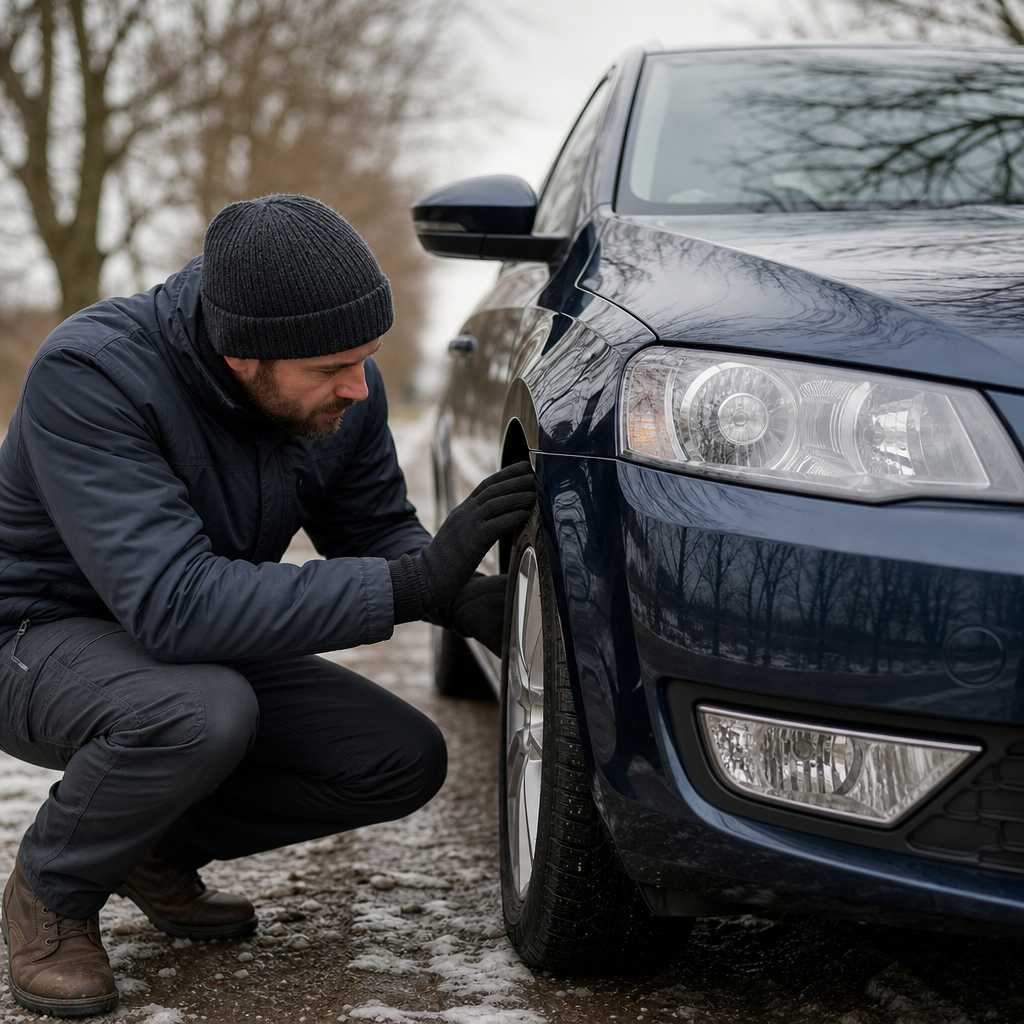
Firstly, tread depth is paramount. While the legal minimum for tread depth in the UK is 1.6mm across the central three-quarters of the tyre's width, for winter driving, we strongly recommend a minimum of 3mm. Below this, tyres become significantly less effective at dispersing water, drastically increasing the risk of aquaplaning and extending braking distances. You can easily check this yourself using the ‘20p coin test’: insert a 20p coin into the main grooves of your tyre. If the outer band of the coin is obscured, your tread is likely above 3mm. If you can see the band, it’s time to consider replacement.
Secondly, tyre pressure needs regular attention. Cold weather causes air to contract, meaning your tyre pressures will drop. Under-inflated tyres compromise handling, increase fuel consumption, and wear unevenly. Check your pressures weekly using an accurate gauge, always when the tyres are cold. Refer to your car’s owner’s manual, the sticker inside the driver’s door jamb, or on the fuel filler flap for the correct pressures.
Finally, consider your tyre type. For the typical UK winter, which often involves more rain and cold than heavy snow, all-season tyres can be an excellent compromise. Marked with an 'M+S' (Mud and Snow) symbol and often the '3PMSF' (Three-Peak Mountain Snowflake) symbol, these tyres offer better grip in cold conditions (below 7°C) and light snow compared to standard summer tyres, without the need to swap to dedicated winter tyres. If you live in an area prone to regular heavy snowfall or steep icy inclines, dedicated winter tyres remain the superior choice for those specific conditions.
Powering Through: Battery Health
Cold weather is a battery’s worst enemy. Batteries are less efficient at lower temperatures, and a cold engine requires more power to crank over. This combination can quickly expose a weak or ageing battery, leading to frustrating non-starts.
Look out for signs of a failing battery:
- Slow cranking: Does your engine sound sluggish or take longer than usual to start?
- Dimming lights: Do your headlights dim noticeably when you try to start the car?
- Warning lights: Are any dashboard warning lights flickering when you start the engine?
- Age: If your battery is more than 3-5 years old, it’s living on borrowed time in winter.
Visually inspect your battery terminals for any signs of corrosion (a white or blue powdery substance) and ensure the connections are secure. However, the best way to assess battery health is with a professional test. Most garages and breakdown services offer free battery health checks, which measure its cold-cranking amps and overall charge capacity. If you don't use your car often, especially in winter, investing in a trickle charger can help maintain optimal battery health.
Seeing and Being Seen: Visibility Essentials
Good visibility is non-negotiable in winter. Reduced daylight hours, fog, rain, and road spray mean you need to see clearly and ensure others can see you.
Start with your wiper blades. Inspect them for cracks, tears, or hardened rubber. When you use them, do they clear the windscreen effectively, or do they leave streaks, smears, or unwiped patches? Worn blades are not just an annoyance; they significantly reduce visibility. They are inexpensive to replace, and it’s a job you can often do yourself.
Next, check your screen wash levels. This is critical for clearing the grime, salt, and muck thrown up by other vehicles. Crucially, ensure you’re using a proper winter-specific screen wash with anti-freeze properties (e.g., rated to -5°C or -10°C). Using just water, or a summer-strength solution, risks it freezing in the reservoir, lines, or jets, leaving you with no way to clean your screen when you need it most.
Finally, inspect all your exterior lights. This includes dipped and full-beam headlights, tail lights, brake lights, indicators, and front and rear fog lights (if fitted). Don’t forget your number plate lights! Ask a friend to help, or park facing a reflective surface (like a garage door) to check the lights yourself. Clean the lenses regularly – road dirt can dramatically reduce light output. Correctly aligned headlights are also vital to avoid dazzling oncoming drivers and to ensure maximum illumination of the road ahead.
Under the Bonnet: Fluids and Protection
Beneath the bonnet, several fluids are vital for your car’s safe and reliable operation, especially when temperatures plummet.
The most critical winter fluid is anti-freeze, which is part of your engine's coolant system. Its primary role is to prevent the coolant from freezing and expanding, which can cause catastrophic damage like a cracked engine block or cylinder head. Check the level in the expansion tank when the engine is cold – it should be between the 'min' and 'max' marks. Never open a hot coolant system! More importantly, check the strength of your anti-freeze; garages can do this quickly with a refractometer. Anti-freeze also contains corrosion inhibitors, which degrade over time, so ensure it’s changed according to your manufacturer's recommendations (typically every 3-5 years).
While you’re under the bonnet, check your engine oil level using the dipstick (again, when the engine is cold and on a level surface). Ensure it’s between the marks. The correct oil viscosity, as specified in your owner’s manual, is also important for easy cold starting. Also, briefly check the levels of your brake fluid and, if applicable, power steering fluid. Any significant drop in these could indicate a leak or other serious issue.
Prepared for the Worst: Your Winter Emergency Kit
Despite all your preparations, unexpected breakdowns can happen, especially in harsh winter conditions. Being prepared can turn a potentially dangerous situation into a manageable inconvenience. Build a dedicated winter emergency kit for your car’s boot.
Here’s what we recommend including:
- Fully charged mobile phone and power bank: Essential for calling for help.
- Reflective warning triangle: To place behind your vehicle to alert other drivers.
- High-visibility vest: A legal requirement in some European countries, and excellent practice here for safety when outside your vehicle on a hard shoulder.
- Torch: With spare batteries or a wind-up model.
- First-aid kit: For minor injuries.
- Warm blankets or a sleeping bag: For warmth if you're stranded for an extended period.
- Extra warm clothing: Hat, gloves, scarf – these can be lifesavers.
- Non-perishable food and water: Energy bars, chocolate, a bottle of water.
- Jump start cables: Know how to use them safely, or keep them for roadside assistance.
- Tow rope: For minor recovery, though professional assistance is always recommended for serious breakdowns.
- Small shovel: A foldable snow shovel can be invaluable for digging out of light snow.
- De-icer and ice scraper: For clearing windows and mirrors.
- Bag of sand, cat litter, or old carpet mats: To put under drive wheels for traction on ice or snow.
Finally, ensure your breakdown cover membership is current and you have the contact number readily available.
Conclusion
Navigating the UK winter can be challenging, but with a little foresight and effort, you can significantly enhance the safety, reliability, and peace of mind associated with your used car. These essential checks – from tyre condition and battery health to visibility and emergency preparedness – are not just about passing an MOT; they are about protecting yourself, your passengers, and your investment. Don't delay; make these winter checks a priority before the worst of the weather truly sets in. A little preparation now will ensure your used car remains road-ready and reliable, no matter how cold or wet it gets.