Juicing Up at Home: A UK Guide to Home Charging for Used EV Owners
The UK's roads are seeing an electric revolution, and the used EV market is booming. More and more drivers are discovering the joys of instant torque, quiet journeys, and significantly lower running costs. However, for many transitioning from petrol or diesel, understanding the ins and outs of charging can feel like navigating a new galaxy. While public charging networks are expanding rapidly, the real game-changer for most EV owners is the convenience and cost-effectiveness of charging at home.
Imagine waking up every morning to a "full tank" of electricity, ready for the day ahead, all at a fraction of the price of petrol. This guide from CarsLink.ai is designed to demystify home charging for used EV owners, covering everything from charger types and government grants to installation requirements and optimising your charging routine. Get ready to plug in and power up with confidence!
Demystifying EV Home Charger Types and Connectors
When it comes to home charging, you'll primarily encounter two main types of AC (Alternating Current) chargers, alongside a crucial connector standard.
Slow Chargers (3kW): Often referred to as "trickle chargers," these typically use a standard 3-pin domestic plug (BS 1363, also known as a granny charger or Mode 2 charger). They usually come with the car and are useful for occasional top-ups or emergencies. At 3kW, charging is very slow – adding about 10-15 miles of range per hour. A full charge for a typical 50kWh EV could take 15-20 hours, making it impractical for daily use.
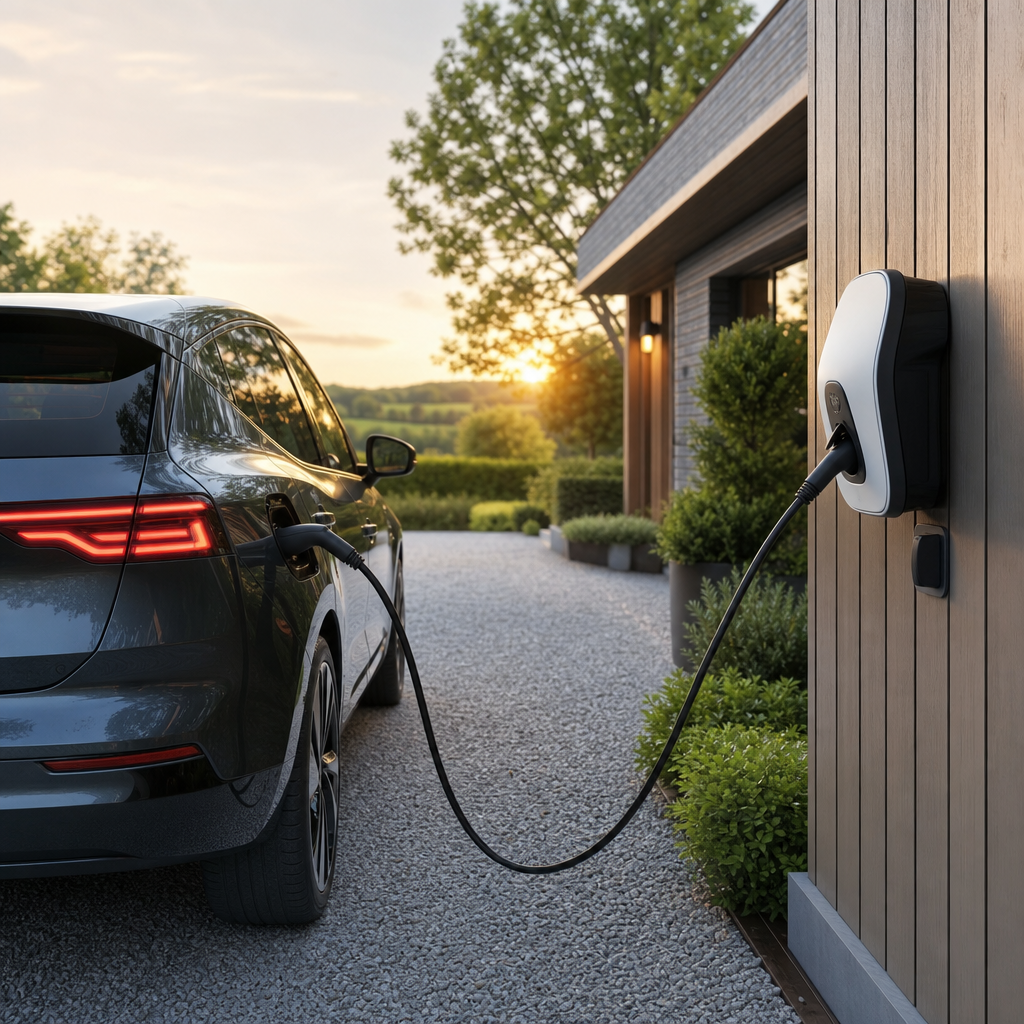
Fast Chargers (7kW and 22kW): These are dedicated wall-mounted units (Mode 3 chargers) that connect directly to your home's electricity supply.
- 7kW: This is by far the most common and recommended home charging solution for most UK households. Connected to a standard single-phase domestic electricity supply, a 7kW charger can add approximately 25-30 miles of range per hour. This means even a large EV battery (e.g., 70kWh) can be fully charged overnight (8-10 hours). It’s powerful enough for daily needs without requiring significant electrical upgrades in most homes.
- 22kW: While faster, 22kW fast chargers require a three-phase electricity supply. This is very rare in UK residential properties, usually only found in larger commercial premises or some new-build developments. If your home has single-phase power (which is most likely), a 22kW charger is not an option, regardless of the wallbox you buy. Even if you did have three-phase, many used EVs won't be able to accept 22kW AC charging anyway, often maxing out at 7kW or 11kW.
Rapid Chargers (50kW+): It's important to note that rapid DC (Direct Current) chargers are not suitable for home installation. These are found at public charging stations and motorways, delivering very high power to quickly charge your EV, bypassing the car's onboard AC-DC converter.
Connector Compatibility: For home charging, the Type 2 (Mennekes) connector is the standard in the UK and Europe. Your home wallbox will either have a tethered cable with a Type 2 plug or a Type 2 socket, allowing you to use your car's Type 2 charging cable. Almost all modern EVs sold in the UK use a Type 2 port for AC charging. For rapid public charging, most EVs use a CCS (Combined Charging System) connector, which is essentially a Type 2 port with two additional pins for DC power.
Navigating UK Government Grants and Financial Incentives
The UK government has been proactive in encouraging EV adoption, and this includes supporting home charging infrastructure. While the popular Electric Vehicle Homecharge Scheme (EVHS) has closed to homeowners with driveways, there are still grants available that can significantly reduce the cost of installing a home charger.
The primary incentive now is the EV Chargepoint Grant, administered by the Office for Zero Emission Vehicles (OZEV). This grant offers a discount of up to £350 towards the cost of purchasing and installing a new smart chargepoint. However, the eligibility criteria have changed:
- Renters and Flat Owners: The grant is primarily aimed at individuals who live in rented properties or own a flat. This is designed to help those who might face additional hurdles in getting a charger installed due to landlord or property management permissions.
- Properties with On-Street Parking: The grant also covers owners of single-unit properties (i.e., houses) who do not have dedicated off-street parking, but instead rely on on-street parking for their EV. This acknowledges the unique challenges faced by these homeowners.
To be eligible, you must:
- Own or have ordered an eligible EV (including used EVs).
- Live in an eligible property type.
- Use an OZEV-approved installer.
- Install an OZEV-approved chargepoint.
The grant is claimed directly by your chosen OZEV-approved installer, who will deduct the £350 from your invoice. This means you only pay the subsidised amount. Always check the latest eligibility criteria on the GOV.UK website as schemes can evolve. While homeowners with driveways are no longer directly eligible for the home chargepoint grant, the overall cost of a 7kW charger and installation has become more competitive, making it a worthwhile investment even without a direct subsidy.
Understanding Electrical Requirements and Professional Installation
Installing an EV home charger isn't a DIY job; it's a significant electrical modification that requires professional expertise. Understanding your home's electrical setup is crucial before you even start looking at chargers.
Single-Phase vs. Three-Phase Electricity: As mentioned, most UK homes operate on a single-phase electrical supply. This typically limits your home charger to a maximum of 7kW. If you have a three-phase supply (more common in commercial buildings or larger, older properties), you could potentially install a 22kW charger, but this is rare. An installer will confirm your supply type during the initial survey.
Consumer Unit (Fuse Box) Capacity: Your existing consumer unit might need an upgrade if it doesn't have sufficient capacity or a spare way for the new circuit breaker required for the EV charger. Modern consumer units are generally robust, but older ones may struggle to safely accommodate the continuous high load of an EV charger alongside your usual household appliances.
Earthing Arrangements: EV chargers have specific earthing requirements to ensure safety, particularly if your property has a TN-C-S earthing system (the most common type). An installer will need to ensure compliance with BS 7671 (the IET Wiring Regulations), which might involve installing a separate earthing rod (TT earthing system) or using a chargepoint with built-in PME fault detection.
The Process of Finding a Certified Installer: This is where OZEV-approved installers come in. Their certification means they:
- Are qualified electricians.
- Have specific training in EV chargepoint installation.
- Are approved to claim OZEV grants on your behalf (if applicable).
- Will ensure your installation meets all current safety regulations (BS 7671).
Here's how the process typically works:
- Get Quotes: Contact several OZEV-approved installers for quotes. They will often perform a desk-based assessment initially, asking for photos of your consumer unit, proposed chargepoint location, and parking area.
- Home Survey: A more detailed physical survey may be required, especially if the installation is complex, to assess your electrical supply, cable routing, and earthing.
- Installation: Once you've approved a quote, the installer will schedule the installation. This typically takes a few hours.
- Certification: Upon completion, the installer will issue an Electrical Installation Certificate, confirming the work complies with regulations. They will also process any applicable OZEV grant claims.
Choosing an approved installer ensures not only safety and compliance but also peace of mind, knowing your new charging setup is robust and reliable.
Optimising Home Charging for Battery Health and Cost Savings
Once your home charger is installed, you can start making the most of it – not just for convenience, but also for prolonging your EV's battery life and significantly reducing your running costs.
Optimising for Battery Health: EV batteries are robust, but a few simple habits can help them last longer:
- Aim for 80% for Daily Use: Routinely charging to 100% can put a slight strain on the battery over its lifetime. For daily commuting, setting your car or charger to stop at 80% or 90% is ideal. Only charge to 100% when you know you'll need the full range for a longer journey.
- Avoid Deep Discharges: Similarly, frequently letting your battery drop below 20% can also reduce its longevity. Try to plug in when convenient, keeping the battery within the "sweet spot" of 20-80%.
- Slow Charging is Better: For battery health, slower AC charging (like your 7kW home charger) is generally preferred over frequent rapid DC charging, as it generates less heat. Think of your home charger as your battery's gentle spa treatment.
- Pre-conditioning: Many EVs allow you to pre-condition the battery and cabin while plugged in. This uses grid power rather than battery power, saving your battery for driving and ensuring optimal performance.
Optimising for Cost Savings with Off-Peak Tariffs: This is where the real financial benefits of home charging kick in.
- Smart Energy Tariffs: Switch to an EV-specific smart energy tariff (e.g., Octopus Go, EDF GoElectric, British Gas Hive EV, OVO Drive). These tariffs offer significantly cheaper electricity rates during off-peak hours, typically overnight (e.g., 00:30 to 04:30). The savings can be dramatic, often bringing the cost of "fuel" down to the equivalent of 1-3 pence per mile.
- Smart Chargers and Scheduling: Most modern home chargers are "smart," meaning they can connect to Wi-Fi and be controlled via an app. Use this feature (or your car's own charging schedule) to automatically initiate charging only during your off-peak hours. You can plug in as soon as you get home, and the charger will wait until the cheap rate kicks in.
- Solar Integration: If you have solar panels, some smart chargers can be integrated to prioritise using surplus solar energy to charge your car during the day, further reducing your reliance on grid electricity.
By combining these strategies, you're not just charging your EV; you're intelligently managing your energy, saving money, and protecting your investment for years to come.
Conclusion
Home charging is the backbone of convenient and cost-effective EV ownership. While the initial outlay for a dedicated wallbox and installation might seem like an extra step, the long-term benefits are undeniable: the unparalleled convenience of waking up to a fully charged car, significant savings on "fuel" costs thanks to smart tariffs, and the peace of mind that comes with knowing your battery is being cared for.
As a used EV owner, embracing home charging will transform your daily driving experience, making electric mobility truly seamless and enjoyable. So, take the plunge, find an OZEV-approved installer, and get ready to plug into the future. Your used EV – and your wallet – will thank you for it. For your next electric adventure, don't forget to browse the fantastic range of used EVs available on CarsLink.ai!