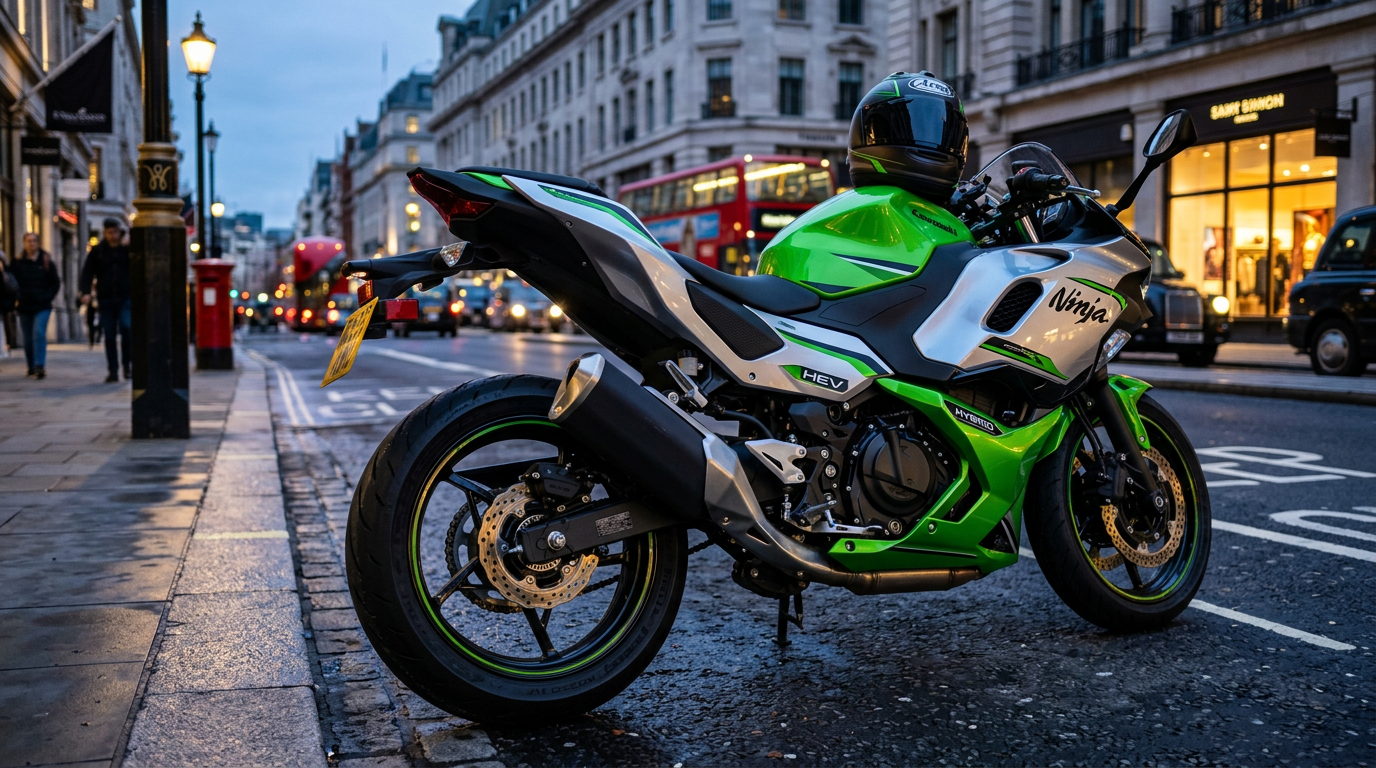
Since its groundbreaking release, the Kawasaki Ninja 7 Hybrid (HEV) has redefined what riders expect from a mid-capacity machine. As we move through 2026, the second-hand market for these innovative bikes has matured, making a used Kawasaki Ninja 7 Hybrid one of the most intriguing prospects for the tech-savvy UK rider.
Combining a 451cc parallel-twin internal combustion engine (ICE) with a 7kW traction motor, this bike offers the punch of a 700cc machine with the fuel economy of a 250cc commuter. In this 2026 buying guide, we explore whether this petrol-electric pioneer deserves a spot in your garage.
The Hybrid Proposition: Why Buy Used in 2026?
By mid-2026, the initial "early adopter" depreciation curve has settled. Buying a pre-owned Ninja 7 Hybrid now allows you to bypass the steep initial VAT drop while still owning a machine that remains at the cutting edge of motorcycle technology.
Unlike traditional ICE bikes, the Ninja 7 Hybrid offers three distinct riding modes that change its character entirely:
- Sport-Hybrid: Maximum power, utilizing the "E-Boost" function.
- Eco-Hybrid: A balance of electric propulsion and engine power for touring.
- EV Mode: Silent, zero-emission running for short distances (ideal for low-speed urban crawls or avoiding waking the neighbours).
2026 UK Road Tax and Running Costs
One of the primary drivers for the Hybrid motorbike UK buying guide is the shifting landscape of VED (Vehicle Excise Duty).
In 2026, the UK government has streamlined road tax, but the Ninja 7 Hybrid still holds an edge in urban environments. While it attracts standard motorcycle tax rates based on engine capacity (the 451cc bracket), its real saving comes at the pump. Owners are reporting a genuine 80–90 mpg in mixed commuting—figures usually reserved for 125cc scooters.
| Feature | Specification / Requirement |
|---|---|
| Engine Capacity | 451cc + 7kW Electric Motor |
| Licence Required | Full A Licence (not A2 compatible) |
| 2026 Road Tax (Est) | Standard >400cc Rate |
| ULEZ Status | Fully Compliant (Exempt from charges) |
| Service Interval | 7,500 Miles / 12 Months |
What to Look for When Inspecting a Used Ninja 7
Buying a used Kawasaki Ninja 7 Hybrid requires a slightly different checklist than a standard Z650 or Ninja 400.
1. Battery Health and Cycles
The 48V lithium-ion battery is the heart of the HEV system. When viewing a bike, ensure the dashboard shows a healthy charge hold. Unlike cars, these batteries are compact and situated under the seat; check for any signs of heat stress or aftermarket wiring 'taps' that might have voided the warranty.
2. Transmission Smoothness
The Ninja 7 uses an automated manual transmission with no clutch lever. During your test ride, listen for clunks when the bike shifts between the electric motor and the petrol engine. It should be seamless. If the bike "hunts" for gears in Eco-Hybrid mode, it may need a software update or a sensor calibration.
3. The "Walk Mode" Function
Test the "Walk Mode" (forward and reverse). It’s a heavy bike due to the battery weight, and this feature uses the electric motor to assist parking. If this feels jerky, it could indicate an issue with the traction motor controller.
4. Service History
Because of the complexity of the HEV system, a full Kawasaki dealer service history is non-negotiable. Specialist diagnostic tools are required to clear codes and update the hybrid management software. Check the V5C to ensure all recalls—common in early 2024/25 models—have been addressed.
Resale Value and Market Trends in 2026
The HEV motorcycle resale value has remained surprisingly robust. As ULEZ-style zones expand across various UK cities in 2026, the demand for "green" performance bikes has spiked.
At CarsLink.ai, we’ve observed that Ninja 7 Hybrids with under 10,000 miles are retaining roughly 60-65% of their original RRP after two years. This is slightly better than pure electric superbikes, which suffer from "range anxiety" in the used market. The Ninja 7 avoids this by having a petrol tank, making it a safer bet for used buyers.
Riding Experience: Life Without a Clutch
For the traditionalist, the lack of a clutch lever is the biggest hurdle. However, in the stop-start traffic of London, Manchester, or Birmingham, the automated shifting is a revelation. In Sport-Hybrid mode, the E-Boost provides a torque kick that rivals 1000cc bikes for the first few seconds of acceleration. It is a "point-and-shoot" machine that makes overtaking effortless.
Licence and Legalities
Remember, despite the 451cc engine, the combined power output puts this bike firmly in the Full A Licence category. Do not buy this thinking you can ride it on a CBT or an A2 restricted licence; the DVSA categorises it based on its peak power output when the electric motor assists.
Verdict: Should You Buy One?
The Kawasaki Ninja 7 Hybrid is the bridge between the past and the future. By 2026, the technology has proven itself reliable, and the used market offers a more palatable entry price.
Pros:
- Incredible fuel economy for the performance level.
- Silent EV mode is perfect for city centres.
- Unique "E-Boost" technology is genuinely fun.
- Stronger resale value than many pure-EV rivals.
Cons:
- Heavier than a standard 600cc sports bike.
- Complex electronics require specialist servicing.
- Under-seat storage is almost non-existent due to the battery.
If you are looking for a futuristic commuter that can still hold its own on a Sunday blast through the Cotswolds, a used Ninja 7 Hybrid is a stellar choice. Check the latest listings on CarsLink.ai to find verified examples with comprehensive service histories.
Ready to make the switch to hybrid? Browse our curated selection of high-tech motorcycles on CarsLink.ai today and find your next ride with confidence.