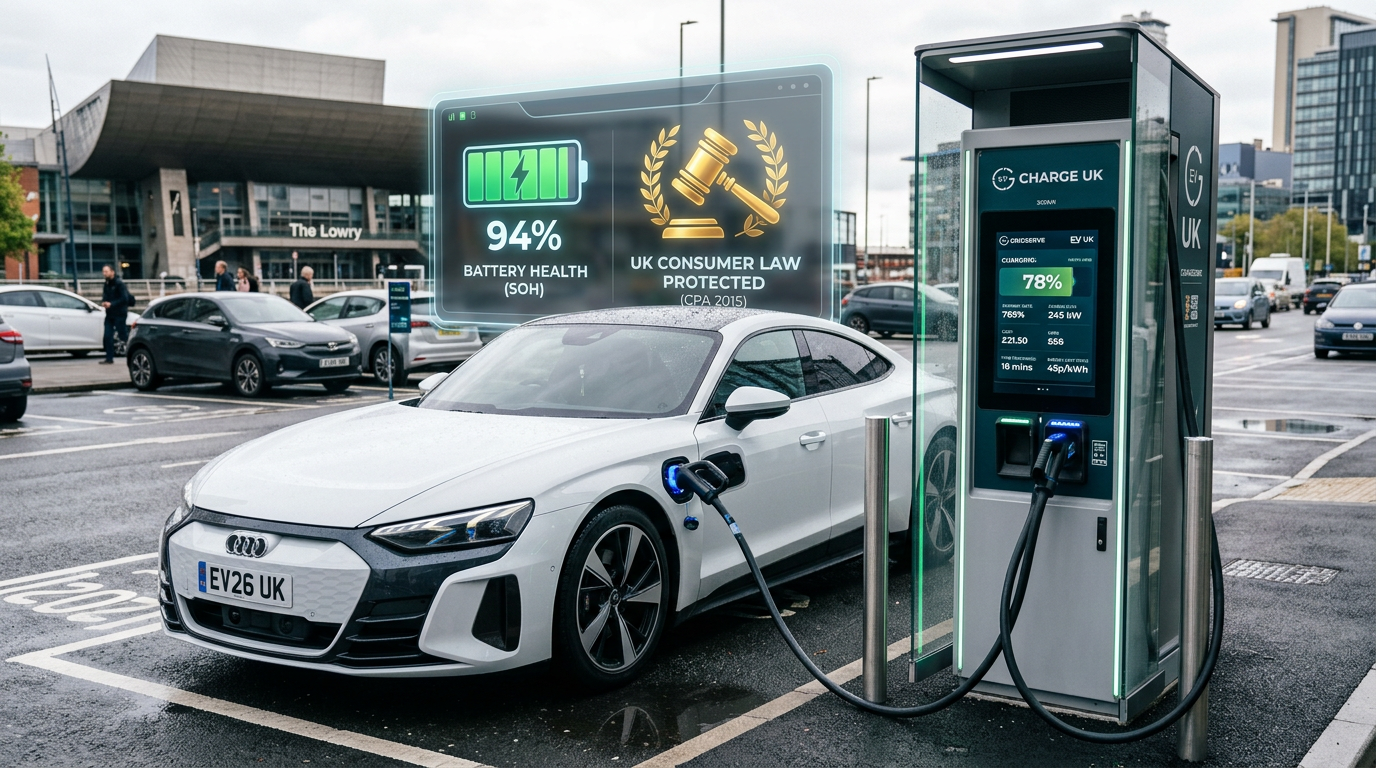
As we move further into 2026, the UK used electric vehicle (EV) market has matured significantly. With more second-hand EVs on the road than ever before, a pressing question has emerged for consumers: what happens if the battery doesn't hold the charge it used to?
While most modern EV batteries are designed to outlast the vehicle, degradation is a natural chemical process. However, there is a fine line between expected "wear and tear" and a battery that is legally "unsatisfactory." Navigating this distinction requires a firm understanding of the Consumer Rights Act 2015 (CRA 2015) and how UK law views the high-voltage heart of your car.
Key Takeaways
- The Consumer Rights Act 2015 protects you against batteries that are not of "satisfactory quality" at the point of sale.
- The first six months after purchase are critical; the "burden of proof" lies with the dealer to show the fault wasn't there at delivery.
- Natural degradation (e.g., 2% per year) is generally considered fair wear and tear, whereas sudden capacity drops may be deemed a "fault."
- Third-party battery health certificates are becoming the "Gold Standard" for legal evidence in consumer disputes.
Your Buyer Rights: The Consumer Rights Act 2015
When you purchase a used EV from a professional trader in the UK, the Consumer Rights Act 2015 is your primary shield. Under this Act, every vehicle sold must be:
- Of satisfactory quality: What a reasonable person would expect based on the car's age, price, and mileage.
- Fit for purpose: If you told the dealer you needed to travel 150 miles on a single charge and the car can only do 80, it may not be fit for purpose.
- As described: If the listing claimed "95% Battery State of Health (SOH)" and it is actually 75%, you have a clear claim.
The "Six-Month" Rule
In 2026, the timeline of your claim is the most important factor:
- 0 – 30 Days (Right to Reject): If you discover a significant battery fault (e.g., a defective cell or capacity far below what was advertised), you have a short-term right to reject the car for a full refund.
- 30 Days – 6 Months: If a fault develops, it is legally presumed that the fault existed at the time of delivery. The dealer must be given one opportunity to repair or replace the battery. If they cannot, you are entitled to a price reduction or a final right to reject (subject to a deduction for use).
- 6 Months – 6 Years: You can still claim, but the "burden of proof" shifts to you. You must prove the battery was defective at the point of sale, which usually requires an expert engineer’s report.
Section 75 of the Consumer Credit Act 1974
If you paid even a £100 deposit on a credit card for an EV costing between £100 and £30,000, or if you used Hire Purchase (HP) or PCP, you have additional protection. Under Section 75, the finance provider is "jointly and severally" liable with the dealer for any breach of contract or misrepresentation. This is a vital safety net if the dealership goes bust.
Dealer and Trader Obligations
Traders are under strict legal obligations defined not just by the CRA 2015, but also by the Consumer Protection from Unfair Trading Regulations 2008 (CPRs 2008).
Transparency and Disclosure
A dealer cannot stay silent about a known battery issue. The CPRs 2008 prohibit "misleading omissions." If a dealer knows an EV battery has significantly degraded—perhaps it was previously used as a high-cycling taxi and has a State of Health (SOH) of 70%—they must disclose this.
Failure to disclose material information that would affect a consumer’s decision to buy is a criminal offence and gives the buyer the right to seek "unwinding" of the contract.
The Standard of "Satisfactory Quality"
For a 2026 trader, "satisfactory quality" is a sliding scale.
- A 3-year-old EV: A consumer expects very little degradation (typically 3-6% from new). A 20% drop would likely be considered a fault.
- An 8-year-old EV: A consumer should expect more degradation. If a ten-year-old Nissan Leaf has lost three "bars" of health, a court may rule this is "satisfactory" for its age and price.
Liability for Advice
Under the Financial Services and Markets Act 2000 (FSMA 2000), if a dealer provides specific financial advice regarding battery leasing or insurance-backed warranties, they must be authorised by the FCA. In 2026, many dealers offer "Battery Health Guarantees." Traders must ensure these do not overwrite your statutory rights under the CRA 2015; they are in addition to the law, not a replacement for it.
EV Battery Warranties vs. Statutory Rights
Most EVs come with an 8-year/100,000-mile battery warranty. However, by 2026, many early "mass-market" EVs (like 2017/2018 models) are exiting this manufacturer coverage.
It is a common misconception that if a car is out of its manufacturer warranty, you have no rights. Your CRA 2015 rights exist against the seller, regardless of the manufacturer's warranty status. If you buy a 9-year-old EV from a dealer and the battery fails completely two weeks later, the dealer is responsible for the remedy, even if the manufacturer’s warranty expired a year ago.
Proving Degradation: The Evidence You Need
In 2026, "range anxiety" has been replaced by "degradation anxiety." To win a legal dispute under the CRA 2015, you need objective data.
- OBD-II Telematics: Tools like "LeafSpy" or "Aviloo" provide detailed SOH reports.
- Manufacturer Diagnostics: A printout from a main dealer showing cell voltage imbalances can prove a "latent defect."
- Third-Party Audits: Independent battery health certificates are now highly regarded by the Financial Ombudsman Service and the small claims court.
Practical Steps if Your EV Battery is Failing
- Stop Charging to 100%: If you suspect a failing cell (often indicated by the range "dropping" suddenly from 20% to 0%), document it via your dashboard camera or photos.
- Contact the Dealer in Writing: State clearly that you are exercising your rights under the Consumer Rights Act 2015. Use the phrase: "The vehicle is not of satisfactory quality."
- The Repair/Replace/Refund Cycle: Remember the dealer has one chance to fix the battery (e.g., replacing a faulty module). If the fix fails, you move to the refund stage.
- Involve the Finance Company: If the car is on PCP/HP, inform the finance house immediately. They technically own the car and are responsible for ensuring it meets the CRA 2015 standards.
Conclusion
The shift to electric transport hasn't changed the fundamental principle of UK consumer law: you are entitled to a product that works as a reasonable person would expect. While some battery degradation is an inherent feature of the technology, "excessive" or "undisclosed" degradation is a legal fault.
As we navigate the used EV market in 2026, the Consumer Rights Act 2015 remains the most powerful tool in the buyer’s arsenal. Whether it is a faulty cell or a misleading range estimate, the law is designed to ensure you aren't left stranded with a "bricked" battery.
Disclaimer: This article is for general informational purposes only and does not constitute legal advice. Laws regarding consumer rights can change, and the application of the Consumer Rights Act 2015 depends on the specific facts of your case. For specific legal issues, please consult a qualified legal professional or Citizens Advice.