The Final Word on Write-Offs: Understanding the 2026 Salvage Landscape
Navigating the used car market in 2026 requires more than just a keen eye for a polished bonnet. With the rise of advanced driver-assistance systems (ADAS) and complex battery architectures in electric vehicles (EVs), the line between a repairable dent and a lethal liability has never been thinner.
When an insurer deems a vehicle a 'total loss', it is entered into the MIAFTR database (Motor Insurance Anti-Theft and Fraud Register). While some categories allow for a second lease of life, Category A and Category B salvage represent the end of the road.
In this guide, we explore why these classifications exist, the legalities surrounding them, and why a vehicle provenance check via CarsLink.ai is your most vital tool when buying pre-owned.
What Defines a 'Total Loss' in 2026?
A total loss occurs when the cost of professional repair—using original equipment manufacturer (OEM) parts and safety protocols—exceeds a certain percentage of the vehicle’s market value, or when the structure is beyond safe restoration.
The Association of British Insurers (ABI) updated the salvage code several years ago to focus on 'condition' rather than just 'cost'. In 2026, with EVs dominating the UK fleet, structural integrity and battery stability are the primary drivers of write-off decisions.
| Category | Definition | Can it return to the road? |
|---|---|---|
| Category A | Scrap only. High-level damage (e.g., severe fire or crush). | Never |
| Category B | Significant structural damage. Parts may be salvaged. | Never |
| Category S | Structural damage that is repairable. | Yes (Must be declared) |
| Category N | Non-structural damage (e.g., electrics or cosmetic). | Yes (Must be declared) |
Category A: The "Scrap Only" Mandate
Category A is reserved for the worst-case scenarios. These are vehicles that have been involved in high-speed impacts, devastating fires, or total submersions.
Why it must never return: The metal in a Cat A car has usually suffered "work hardening" or heat-treatment changes. In a fire, the molecular structure of the steel or aluminium chassis is compromised, meaning it can no longer absorb energy in a subsequent crash. Even the interior components are considered toxic due to chemical fire suppressants or biological contamination.
Under UK law, a Cat A vehicle must be crushed in its entirety. Not even a single door handle or wing mirror should be resold.
Category B: Salvageable Parts, Dead Chassis
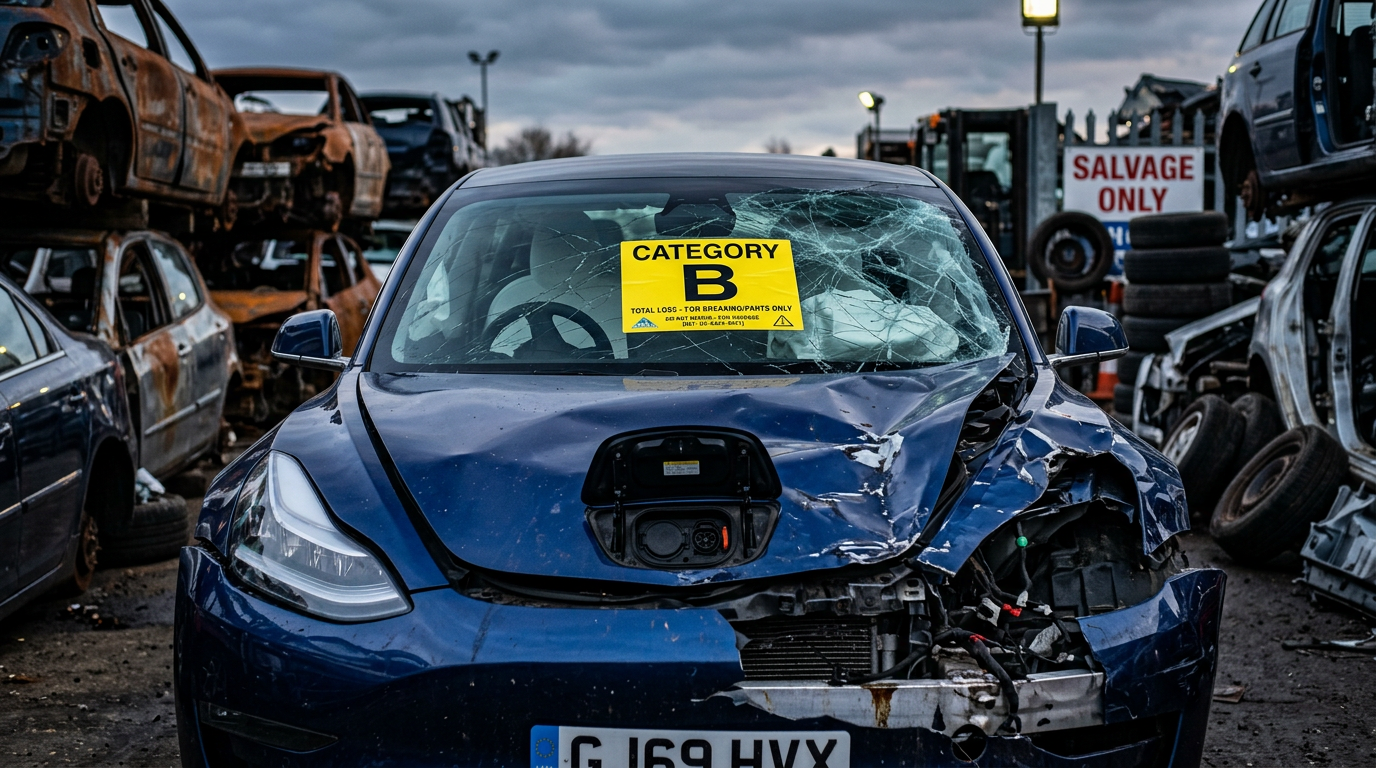
Category B represents a middle ground for recyclers but a hard "no" for road use. The chassis or 'shell' of a Cat B car is deemed structurally unsound, but certain peripheral components—such as the infotainment system, seats, or non-damaged panels—can be harvested.
The 2026 EV Factor: For electric vehicles, a Cat B rating often follows a "venting" event or minor casing damage to the high-voltage battery. While the motor might be fine, the integrity of the battery housing is gone.
Strict Regulations: The V5C (logbook) for a Cat B car is destroyed by the DVLA. If someone attempts to sell you a "repaired" Cat B car, they are committing a serious offence, and the vehicle will be impossible to tax or insure.
The Danger of 'Ghost' Cars and Identity Cloning
Despite the legal barriers, unscrupulous sellers occasionally attempt to bring Cat A or B cars back to life using "cloning." This involves taking the VIN (Vehicle Identification Number) and registration plates from a crashed car and applying them to a stolen vehicle of the same make and colour.
This is why a vehicle provenance check is non-negotiable. At CarsLink.ai, our data integrates directly with the MIAFTR database, flagging instantly if a VIN has been marked for destruction. If a deal looks too good to be true in 2026, the car might literally be a "ghost"—a vehicle that legally ceased to exist months prior.
How to Identify a Total Loss When Buying Used
While Cat S and N cars can be safely returned to the road (provided repairs meet Thatcham standards and are reflected in the price), Cat A and B cars are safety hazards. Here is how to protect yourself:
- Check the V5C: Look for notes in the 'Special Notes' section (Section 3). However, be aware that fraudulent sellers may provide forged documents.
- Inspect the VIN: Ensure the VIN on the dashboard matches the one stamped on the chassis and the one listed on the V5C.
- The 'New MOT' Trap: A fresh MOT certificate does not mean a car hasn't been written off. An MOT only checks roadworthiness at a specific moment; it does not investigate the vehicle's insurance history.
- Run a CarsLink.ai Report: This is the most robust way to see the car write off categories 2026 data. It will confirm if the car has ever been processed through an insurance salvage auction.
The Economic and Legal Consequences
Attempting to put a Cat A or B car back on the road carries severe penalties:
- Insurance Voidance: If you are involved in an accident in a reincarnated Cat A/B car, your insurance is automatically void. You will be liable for all damages, which in 2026 could run into hundreds of thousands of pounds if third-party EVs or infrastructure are damaged.
- DVLA Enforcement: The DVLA will not issue a new V5C for these vehicles. Without a V5C, you cannot pay Road Tax (VED).
- Safety Risk: These cars lack the structural integrity to protect occupants. In a 2026 Euro NCAP-standard environment, a compromised chassis is a death trap.
Summary: Trust the Data, Not the Seller
As we move further into an era of high-tech motoring, the "cut and shut" or "repaired wreck" becomes harder to spot with the naked eye. Sophisticated sensors can hide beneath poorly welded panels.
The MIAFTR database exists to protect the public from vehicles that should have been recycled into soda cans or EV battery components. By insisting on a detailed vehicle provenance check, you ensure that your next car purchase is a smart investment rather than a dangerous liability.
Before you part with your money, ensure the car's history is as clean as its bodywork. Use CarsLink.ai today to verify the category status of any UK vehicle and drive with total peace of mind.