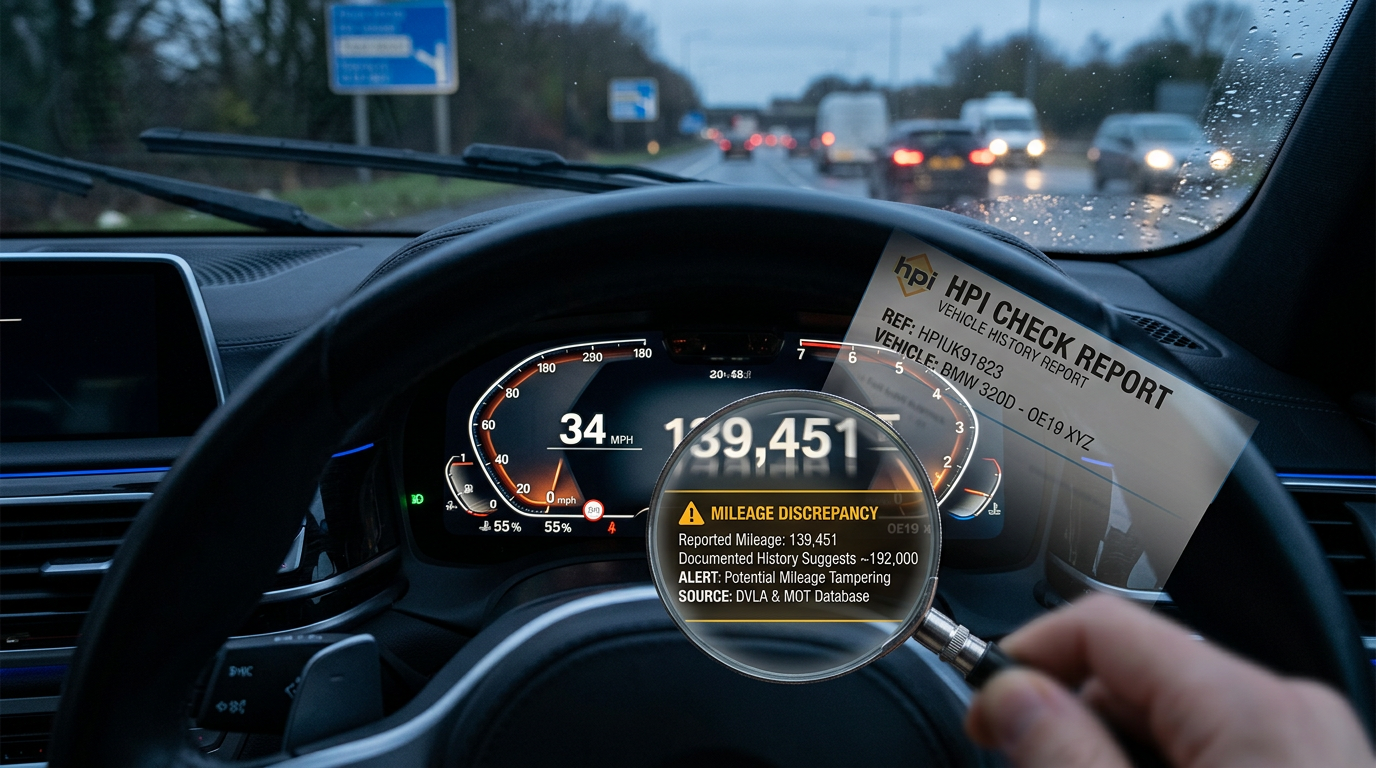
Vehicle 'clocking'—the illicit practice of winding back a car's odometer to increase its resale value—remains one of the most persistent threats to used car buyers in the UK. Despite the shift towards digital instrument clusters and sophisticated ECUs (Electronic Control Units), mileage fraud has evolved rather than disappeared.
In 2026, as the used market sees a massive influx of ex-lease EVs and hybrid vehicles, understanding how to spot an HPI mileage discrepancy is more vital than ever. This guide explores the modern landscape of mileage fraud and how to protect your investment.
What is Car Clocking in 2026?
While the old mechanical odometers could be wound back with a screwdriver, modern cars are "clocked" using software. Fraudsters use diagnostic tools to rewrite the mileage data stored in the car's computer.
With the average PCP (Personal Contract Purchase) agreement in the UK carrying strict mileage caps, some drivers use "mileage blockers"—devices that prevent the car from recording miles during ownership—to avoid hefty end-of-contract penalties. When these cars hit the used market, their recorded mileage is a fraction of the reality, leading to premature mechanical failure and thousands of pounds in lost value for the next owner.
How to Identifying an HPI Mileage Discrepancy
An HPI check remains the gold standard for vehicle history in the UK. When you run a check via a platform like CarsLink.ai, the system cross-references the current odometer reading against multiple databases, including:
- DVLA records
- National Mileage Register (NMR)
- MOT history data
- Service records from participating garages
Reading the HPI Report
If a report flags a "Mileage Discrepancy," it means a previous recording was higher than a subsequent one. For example:
- Jan 2024: 45,000 miles (MOT)
- Jan 2025: 32,000 miles (Service record)
This is a massive red flag. While occasionally a typo by a technician, it usually indicates the mileage has been tampered with.
The 2026 Checklist: Spotting Fraud Physically
Digital records are excellent, but they aren't foolproof—especially if a mileage blocker was used from day one. You must use your eyes to look for "wear-and-tear" inconsistencies.
1. Interior Condition vs. Odometer
If a car shows 20,000 miles but the side bolster of the driver's seat is collapsed, the steering wheel leather is shiny/worn, or the rubber on the brake pedal is worn through to the metal, the car has likely done 60,000+ miles.
2. Service History Synchronisation
In 2026, most manufacturers use Digital Service Records (DSR). Ask the seller for a printout or view it via the car’s infotainment system. Look for gaps. If a car was serviced every 10,000 miles for the first three years and then has a two-year "gap" before being sold, be suspicious.
3. Tyre DOT Codes
Check the four-digit date code on the tyre sidewall (e.g., "1225" means the 12th week of 2025). If a car claims to have done only 8,000 miles but is on its second or third set of tyres, the odometer is likely lying.
Using MOT History to Your Advantage
The UK's MOT history check is a free and powerful tool. Since the DVLA digitised these records, you can see every recorded mileage at the time of the annual test.
| Year of Test | Recorded Mileage | Notes |
|---|---|---|
| 2023 | 12,450 | Pass |
| 2024 | 25,100 | Pass (Advisory on tyres) |
| 2025 | 18,900 | DISCREPANCY DETECTED |
In 2026, the DVLA has integrated more "live" data. Always check the "date of first registration" on the V5C logbook. If the car is over three years old, it must have an MOT history. If the records are missing or show inconsistent jumps, walk away.
The Rise of "Hybrid & EV Clocking"
EVs present a new challenge. Because electric motors have fewer moving parts, they don’t show "engine wear" in the traditional sense. However, battery health is closely linked to mileage.
A car that has been clocked from 80,000 miles down to 30,000 miles will have significantly more battery degradation than expected. In 2026, we recommend using a third-party battery health diagnostic tool during your pre-purchase inspection. If the State of Health (SoH) is only 82% but the mileage is low, the car has likely been used as a high-mileage Uber or delivery vehicle and then clocked.
Legal Protection and Redress
Buying from a private seller offers the least protection. Under the Consumer Rights Act 2015, a car must be "as described." If you discover a discrepancy after a private purchase, recovery of funds is notoriously difficult.
Buying through a reputable dealer or using the verified listings on CarsLink.ai provides a safety net. Dealers are legally obligated to ensure the mileage is accurate. If they sell a clocked car, even unintentionally, you are entitled to a full refund within the first 30 days.
Steps to take if you suspect fraud:
- Contact the Seller: It may be a genuine data entry error at a garage.
- Contact HPI/NMR: Request a secondary investigation.
- Trading Standards: Report the seller if they refuse to acknowledge the evidence.
- Police: Clocking is a criminal offence under the Fraud Act 2006.
Summary
In 2026, technology has made it easier for fraudsters to hide a car's true history, but it has also given buyers better tools to fight back. Never take an odometer reading at face value. Always:
- Run a full HPI and mileage check.
- Verify the MOT history via the DVLA.
- Cross-reference digital service records with physical wear.
- Check the V5C for previous owners (e.g., ex-rental or fleet use often implies high mileage).
By staying vigilant and using trusted platforms like CarsLink.ai for your vehicle research, you can avoid the financial pitfall of mileage fraud and ensure your next car is exactly what it claims to be.
Looking for a transparent car buying experience? Browse thousands of verified listings on CarsLink.ai today.