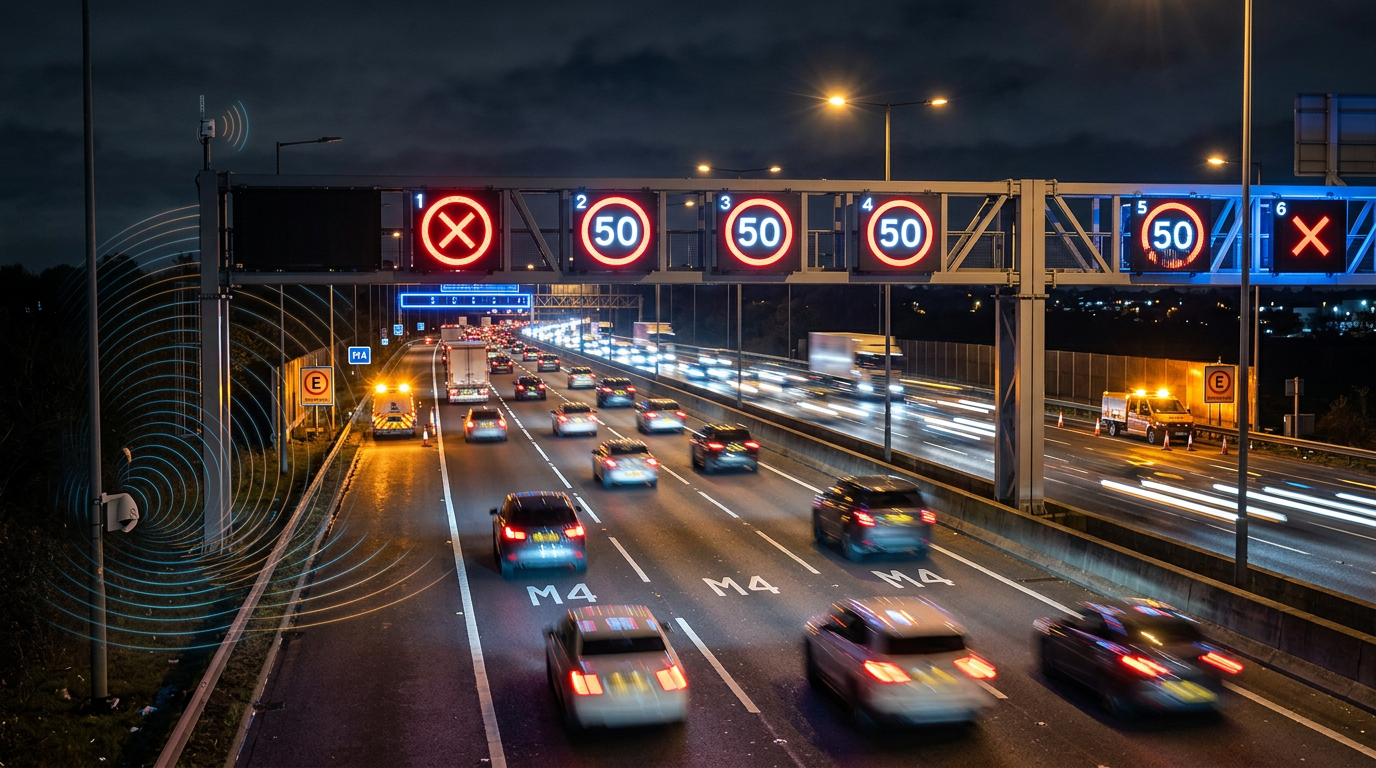
As we navigate through 2026, the UK’s motorway network is undergoing its most significant technological transformation since the introduction of the first 'all-lane running' stretches a decade ago. Following years of public debate and safety reviews, National Highways has officially rolled out the final phase of its Smart Motorway Safety Upgrade programme.
For the British driver, this isn't just about more overhead gantries; it is a fundamental shift in how our cars interact with the road. With the integration of next-generation SVD (Stopped Vehicle Detection) radar and the phasing in of mandatory vehicle-to-infrastructure (V2I) communication, the landscape of UK driving has changed. Whether you are a casual commuter or a high-volume car dealer, understanding these updates is essential for safety, compliance, and maintaining vehicle resale value.
The 2026 Radar Revolution: SVD 2.0
The cornerstone of the 2026 upgrade is the deployment of Enhanced SVD Radar. Previous iterations faced criticism for latency issues, but the new 2026 standard utilises millimetre-wave radar sensors placed every 400 metres along the M1, M6, M25, and M4 corridors.
This tech can now identify a stationary vehicle in live lanes within 10 seconds of it stopping, automatically triggering 'Red X' signals on digital gantries and alerting the National Highways regional control centres.
Why This Matters for Used Car Buyers
When searching for your next vehicle on CarsLink.ai, you’ll notice a new emphasis on 'Connected Tech' in listings. Cars manufactured from 2024 onwards are increasingly equipped to receive these National Highways alerts directly on the dashboard. This isn't just a luxury; it’s a critical safety buffer that gives you extra seconds to react before you even see the overhead gantry.
Vehicle-to-Infrastructure (V2I) Integration
2026 marks the year where the "Smart" in Smart Motorways finally includes the car itself. National Highways is now broadcasting real-time safety data that compatible vehicles can ingest.
- Hazard Warning: If a vehicle is broken down in a live lane 2 miles ahead, your car’s infotainment system will provide an audible and visual warning.
- Speed Synchronisation: Adaptive Cruise Control (ACC) in newer models can now suggest speed adjustments based on variable speed limits before you reach the gantry, reducing 'phantom braking' and improving fuel efficiency.
- Lane Assist Requirements 2026: While not a legal requirement for older cars, insurers are increasingly looking at Lane Keep Assist (LKA) and Lane Departure Warning (LDW) as key factors in premiums for motorway commuters.
Safety Tech Comparison: 2023 vs 2026
The following table highlights the jump in motorway technology standards that drivers and traders should be aware of this year.
| Feature | 2023 Standard | 2026 Standard |
|---|---|---|
| Detection Speed | ~30-60 Seconds | Under 15 Seconds |
| Radar Sensitivity | Prone to heavy rain interference | All-weather AI-filtered radar |
| Emergency Areas (EAs) | Every 1.5 miles (on some routes) | Every 0.75 - 1.0 mile (Standardised) |
| Dashboard Alerts | Limited to high-end EVs/Luxury cars | Standard on most Euro 7 compliant vehicles |
| Enforcement | Gantry-mounted cameras | Integrated AI 'Safety Halo' monitoring |
The "Red X" and Your Licence
The DVLA and National Highways have sharpened enforcement in 2026. Ignoring a Red X is no longer a 'discretionary' offence. New HADECS 3 (Highway Agency Digital Enforcement Camera System) units are now hard-synced with the SVD radar.
If the radar detects a vehicle and triggers a Red X, the cameras are live within milliseconds. The penalty remains a £100 fine and 3 penalty points, but with the 2026 density of cameras, the likelihood of being caught has increased by an estimated 65% compared to three years ago.
Advice for Dealers and Traders
If you are a motor trader, these infrastructure updates should change how you pitch your inventory. In 2026, a car without advanced ADAS (Advanced Driver Assistance Systems) is becoming harder to shift to long-distance commuters.
- Highlight V2X Capability: When listing on CarsLink.ai, explicitly mention if a car supports V2X (Vehicle-to-Everything) communication.
- Verify Lane Assist: Ensure that Lane Keep Assist sensors are calibrated during the MOT or pre-sale service. Buyers are more tech-savvy than ever regarding UK road infrastructure updates.
- Insurance Groups: Cars with higher-tier SVD-compatible tech are seeing lower insurance group ratings, a major selling point given the current cost-of-living climate.
Emergency Areas (EAs): A New Visual Standard
One of the most visible changes in 2026 is the "Safety Orange" overhaul. National Highways has completed the retrofitting of all Smart Motorways to include high-visibility orange surfacing in Emergency Areas.
What to do if you break down:
- Switch on hazards: Even if your car does this automatically.
- Exit left: Try to reach an Emergency Area. If you can’t, move as close to the nearside verge or barrier as possible.
- Get out: Exit via the passenger door and get behind the crash barrier.
- The SOS Button: Most cars from 2018 onwards have an 'eCall' button. In 2026, this system is now directly linked to the Smart Motorway control centres, providing them with your exact GPS coordinates and VIN.
The Future of UK Road Infrastructure
Looking ahead toward 2030, the 2026 upgrade is seen as the "foundation layer" for autonomous freight platooning. The UK remains a leader in this space, and the reliability of the current radar tech is the litmus test for further deregulation of 'hands-off' driving on the M-road network.
For now, the focus remains on safety. The combination of more frequent Emergency Areas and lightning-fast SVD radar aims to make the Smart Motorway the safest road type in Britain, statistically surpassing traditional motorways with permanent hard shoulders.
Summary for Drivers
Whether you're driving a brand-new EV or a trusty 2019 diesel, the 2026 upgrades are designed to protect you. Ensure your vehicle’s software is updated to the latest version to receive over-the-air (OTA) traffic and safety alerts, and always respect the Red X.
Ready to find a car that’s built for the future of UK roads? Use the AI-powered search at CarsLink.ai to filter for vehicles with the latest safety tech, lane assist, and V2I capabilities. Stay safe, stay connected, and stay informed.
[Search the latest SVD-ready cars on CarsLink.ai today.]