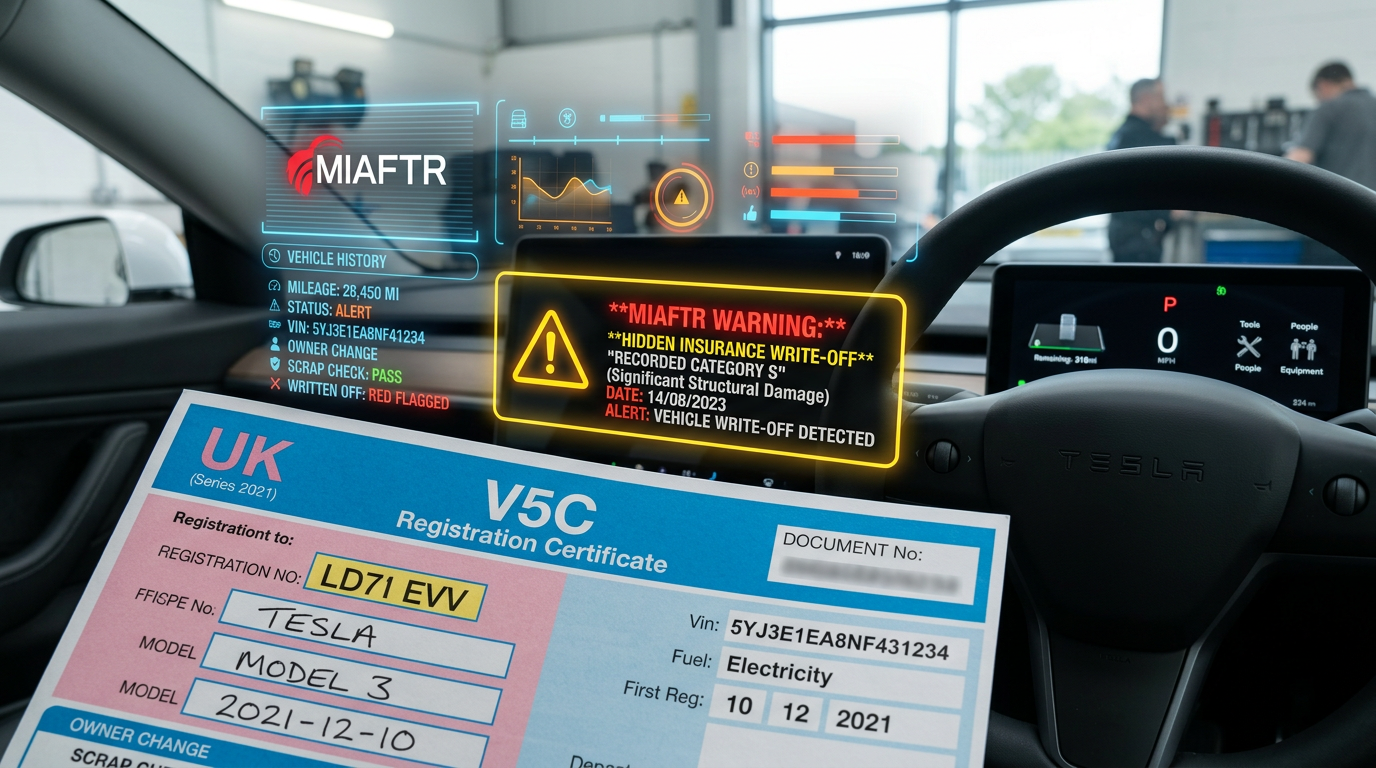
In mid-2026, the UK used car market is more buoyant than ever, but it is also increasingly complex. As electric vehicles (EVs) and high-tech hybrids dominate the forecourts, the cost of repairs has skyrocketed. Consequently, we are seeing a significant rise in 'hidden' total losses—cars that look pristine on the surface but carry a history that could compromise their safety and value.
The biggest misconception among buyers today remains the reliance on the V5C registration certificate (the logbook). Many believe that if a logbook is "clean," the car has never been written off. This is a dangerous assumption. To truly understand a vehicle's history, you must look beyond the DVLA and into the MIAFTR database.
What is MIAFTR and Why Does it Matter?
The Motor Insurance Anti-Fraud and Theft Register (MIAFTR) is a central database managed by MIB (Motor Insurers' Bureau). It contains records of vehicles that have been written off or stolen.
While the DVLA maintains the official record of ownership (the V5C), insurance companies use MIAFTR to share data about claims. In 2026, with the sheer volume of integrated technology in cars, even a minor shunt can lead to a "total loss" designation because the sensors and ADAS (Advanced Driver Assistance Systems) are too expensive to recalibrate or replace.
The Critical Gap: Why the V5C Isn't Enough
The DVLA only records a write-off on the V5C if it falls into specific categories, and even then, there can be a significant time lag. Furthermore, if a vehicle is "self-insured" (often the case with large fleets or delivery firms) or if a claim was settled without the insurer formally categorising it through the standard channels, the V5C might remain "clean."
This is where an unrecorded write-off occurs. A car may have sustained structural damage, been paid out by an insurer, and sold at salvage, yet the logbook shows no "Category" marker. Relying on CarsLink.ai for a comprehensive vehicle provenance check is the only way to bridge the gap between what the DVLA knows and what the insurers have recorded on MIAFTR.
Understanding ABI Salvage Categories in 2026
The Association of British Insurers (ABI) updated its salvage code years ago to focus on the condition of the vehicle rather than just the repair cost. In 2026, these categories are more relevant than ever:
| Category | Definition | Can it return to the road? |
|---|---|---|
| Category A | Scrap only. Total destruction. | No |
| Category B | Break for parts. Chassis must be crushed. | No |
| Category S | Structural damage. Repairable but frame was compromised. | Yes |
| Category N | Non-structural damage. Often electrical or cosmetic. | Yes |
Note on EVs: In 2026, we are seeing more "Category N" write-offs for EVs due to minor battery casing scratches. While technically non-structural, these require specialist inspection to ensure long-term safety.
How Your Logbook Might "Hide" a Total Loss
There are three primary reasons why a V5C might fail to warn you about a car’s dark past:
1. The Processing Lag
It can take several weeks for an insurer to notify the DVLA of a total loss. If a car is "flipped" quickly by an unscrupulous dealer after a salvage auction, the new V5C may be issued before the "Category S/N" marker is applied to the digital record.
2. Third-Party Settlement
If a driver chooses to settle a claim privately or if a small insurance firm bypasses certain reporting protocols, the vehicle may never be recorded as a total loss on the DVLA system, despite being a total loss on the MIAFTR database.
3. "Cash in Lieu" Settlements
In some instances, an insurer may offer a "cash in lieu" settlement where the owner keeps the damaged car and a sum of money. If not handled correctly, this can result in an unrecorded write-off entering the market as a "one-owner, clean history" vehicle.
The Financial Risks of Unrecorded Write-Offs
Buying a hidden total loss isn't just a safety issue; it's a financial disaster.
- Insurance Voids: If you have an accident and your insurer discovers the car was previously an unrecorded write-off, they may refuse to pay out your full claim.
- Resale Value: A "Cat S" or "Cat N" car is typically worth 20-30% less than a clean counterpart. If you pay full market price for a car that is later revealed to be a write-off, you have lost thousands of pounds instantly.
- Safety Compromise: Without a proper vehicle provenance check, you have no way of knowing if the airbags were replaced with genuine parts or if the structural integrity of the crumple zones is intact.
Modern Checks for 2026: Beyond the Paperwork
In 2026, checking the V5C is merely the first step. To protect yourself, follow this checklist:
- Run a Professional History Check: Use a service that hooks directly into the MIAFTR database. This will show insurance claims that never made it to the DVLA.
- Inspect the V5C Watermarks: Ensure the V5C is genuine. Check the "Document Reference Number" and ensure the VIN (Vehicle Identification Number) on the car matches the logbook perfectly.
- Check the MOT History: Look for sudden gaps or "Failures" related to structural components or "Major" leaks, which often hint at hidden accident damage.
- Verify the V5C Issue Date: If the logbook was issued very recently (within the last 2-4 weeks), ask the seller why. It could be a sign of a "quick flip" before a category marker is registered.
Conclusion: Information is Your Best Defence
The V5C is a record of registration and taxation, not a guarantee of quality or safety. In 2026, the complexity of modern vehicles means that the line between "minor damage" and "total loss" is thinner than ever.
Don't gamble with your safety or your bank balance. Before you commit to a purchase, ensure you have seen the full picture of a vehicle's life. At CarsLink.ai, we provide the tools necessary to uncover hidden histories, ensuring that your next car is exactly what it claims to be on the tin.
Ready to buy with confidence? Perform a comprehensive vehicle provenance check at CarsLink.ai today and make sure your dream car isn't a hidden nightmare.