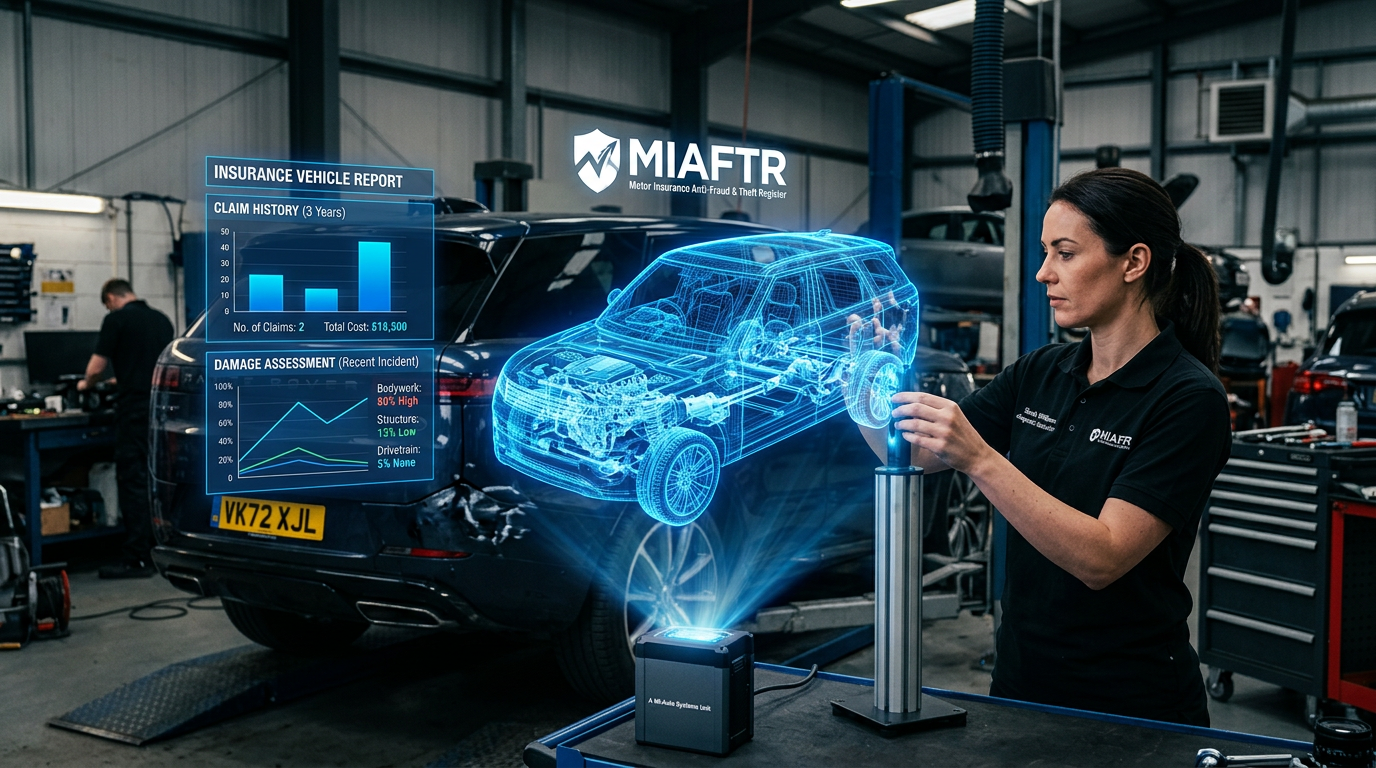
In the UK's 2026 used car market, transparency is everything. With vehicle prices stabilising after years of volatility, buyers are more discerning than ever. However, a shadow still hangs over the industry: unrecorded write-offs. While the DVLA’s V5C logbook is the holy grail for most buyers, it often fails to tell the full story regarding a vehicle's accident history.
To truly protect your investment, you need to understand the MIAFTR (Motor Insurance Anti-Fraud and Theft Register)—a database that holds secrets the logbook won't reveal.
The V5C Myth: Why the Logbook Isn’t Enough
Many motorists believe that if a car has a 'clean' V5C (logbook), it has never been declared a total loss. In 2026, this is a dangerous assumption.
The DVLA is only notified of a write-off when a car is categorized as Category S (Structural) or Category N (Non-structural) and the insurance company follows the formal notification process. However, there is often a significant time lag between an accident and the DVLA records being updated. Furthermore, if a vehicle was self-insured (common with large fleets) or if a claim was settled without the car being officially surrendered to an insurer, the V5C may remain 'clean' while the car's structural integrity is compromised.
What is MIAFTR?
MIAFTR is a central database managed by the Motor Insurers' Bureau (MIB). It was designed to monitor total loss and theft claims to prevent fraud and the 'cloning' of vehicles.
Unlike the DVLA database, which focuses on registration and taxation, MIAFTR tracks the financial status and insurance lifecycle of a vehicle. When an insurer decides that a car is a total loss, the record goes onto MIAFTR almost instantly—long before the V5C is updated or exchanged.
The ABI Salvage Categories: A 2026 Refresher
The Association of British Insurers (ABI) sets the standards for how vehicles are graded after an accident. In 2026, these categories remain the industry standard:
| Category | Definition | Can it return to the road? |
|---|---|---|
| Category A | Scrap only. Total destruction. | No (Never) |
| Category B | Break for parts. Shell must be crushed. | No (Never) |
| Category S | Structural damage that is repairable. | Yes, if professionally repaired. |
| Category N | Non-structural damage (e.g., electronics, cosmetics). | Yes, safely. |
The "MIAFTR Secret" lies in the fact that a vehicle can be logged as a total loss on MIAFTR, but if the owner keeps the car and repairs it privately (a 'cash-in-lieu' settlement), the V5C might never reflect the "S" or "N" designation.
How "Unrecorded" Write-offs Slip Through
An "unrecorded write-off" is a colloquial term for a car that should have been a total loss but doesn't appear as such on a standard HPI or basic background check. Here is how it happens in 2026:
- Fleet Self-Insurance: Large rental or corporate fleets often self-insure. If a car is crashed, they may sell it to salvage yards privately without ever involving a traditional insurer who would log the data on MIAFTR.
- Third-Party Only Claims: If a driver is at fault and only has Third Party insurance, their own insurer won't pay for their car. The car might be sold as "salvage" privately, bypassing the official total loss registration.
- The "Cash-in-Lieu" Gap: An insurer offers the owner a payout but lets them keep the damaged car. If the paperwork isn't processed correctly by the insurer’s administrative team, the MIAFTR entry might be delayed or missed.
The Dangers of Buying a Hidden Total Loss
In an era of advanced ADAS (Advanced Driver Assistance Systems) and EV battery integration, a botched repair on a structural write-off is more dangerous than ever.
- Safety Risks: If a Category S vehicle hasn’t been repaired to manufacturer standards, the crumple zones might not work in a second impact.
- Insurance Voids: If you unknowingly buy an unrecorded write-off and later have an accident, your insurer may refuse to pay out the full market value, or void the policy entirely, claiming the car was "not as described" or unroadworthy.
- Resale Value: When you eventually use a professional tool like CarsLink.ai to valuation your car for trade-in, a deep-dive MIAFTR check will reveal the truth, tanking your car's value by up to 50%.
How to Spot the Secrets: A Buyer’s Checklist
To avoid being stung by a car that has skipped the V5C notification, follow these steps:
1. Run a Premium History Check
Not all car checks are equal. Basic £5 checks often only look at the DVLA data. Invest in a premium check that specifically mentions MIAFTR Data Access. This is the only way to see if an insurer has flagged the car as a total loss.
2. Physical Inspection (The 2026 Way)
Modern cars use sophisticated bonding and ultra-high-strength steel. Look for:
- Mismatched Paint: Use a digital paint depth gauge. Variations suggest a respray after an accident.
- Panel Gaps: In 2026, manufacturing tolerances are tighter than ever. Uneven gaps between the bonnet and wings are a red flag.
- Inner Wing Ripples: Open the bonnet and check the structural 'legs'. Any signs of welding or 'pulling' indicate a structural (Cat S) history.
3. Check the MOT History
Use the DVLA's online portal to check the MOT history. Look for sudden "retests" or long periods where the car was off the road (SORN). A car that disappeared for 8 months and then reappeared with a fresh MOT often hints at a major repair period.
4. Consult the Experts
Using platforms like CarsLink.ai provides you with the data-driven insights needed to navigate the used car market safely. Our tools help bridge the gap between what a seller tells you and what the insurance databases actually show.
The Legal Side: Consumer Rights Act 2015
If you buy a car from a dealer that is later revealed to be an unrecorded write-off, you are protected by the Consumer Rights Act 2015. The car must be "of satisfactory quality" and "as described." A dealer failing to disclose a total loss status—even if it wasn't on the V5C—is often grounds for a full refund.
However, private sales offer far less protection. In a private sale, the onus is on the buyer (Caveat Emptor), making the MIAFTR check an absolute necessity.
Summary
The V5C logbook is a starting point, but it is not the final word on a car's history. In 2026, as vehicles become more complex and repair costs soar, more cars are being written off for seemingly minor damage.
By checking the MIAFTR database, understanding ABI salvage categories, and performing a thorough physical inspection, you can ensure that the "bargain" you've found isn't a hidden total loss waiting to cost you thousands.
Protect yourself by using professional valuation and history tools. Visit CarsLink.ai today to ensure your next vehicle purchase is transparent, safe, and worth every penny.