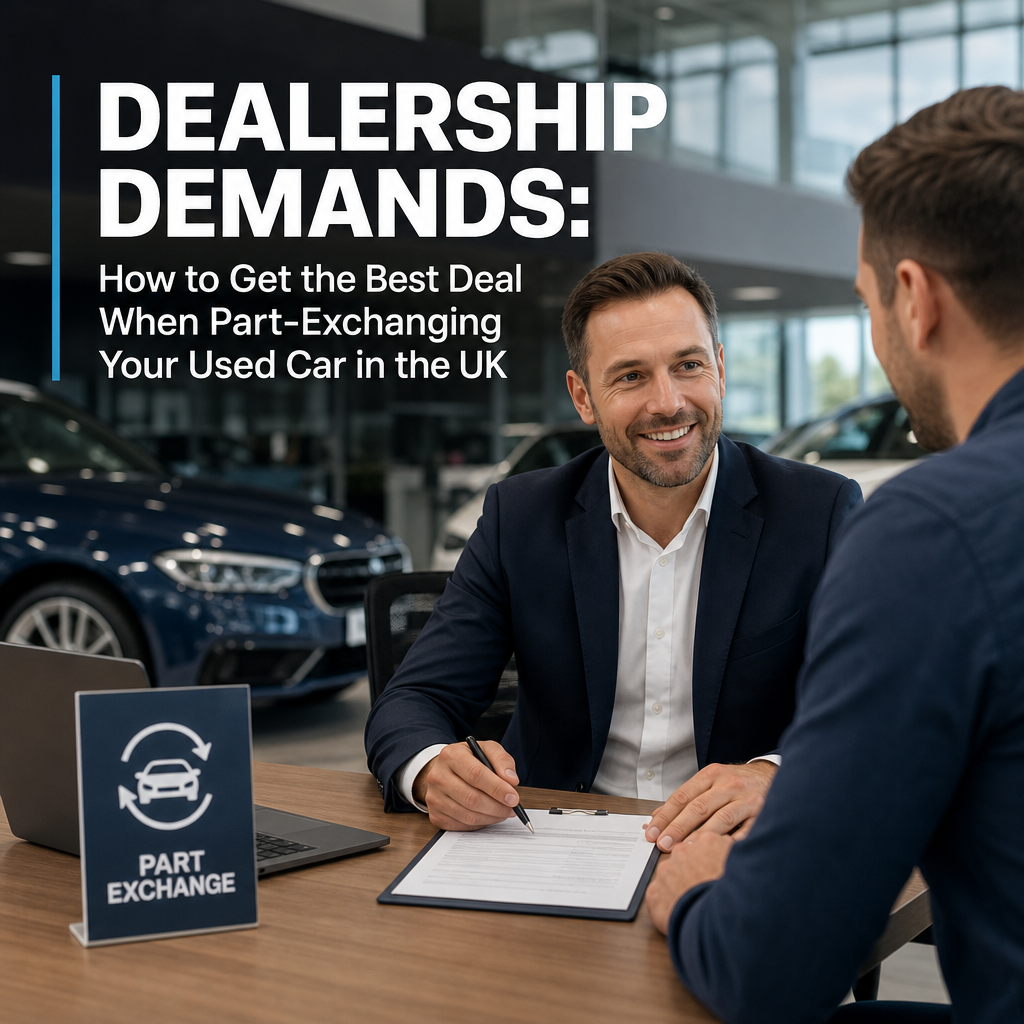
Dealership Demands: How to Get the Best Deal When Part-Exchanging Your Used Car in the UK
Part-exchanging your current car when buying a new or used vehicle can be incredibly convenient. It saves you the hassle of advertising, dealing with potential buyers, and handling the paperwork associated with a private sale. However, this convenience often comes at a cost: dealers typically offer a lower price than you might achieve selling privately. The good news is, with a bit of savvy preparation and negotiation, you can significantly improve the part-exchange offer and ensure you're getting the best possible deal.
At CarsLink.ai, we understand that every penny counts. This guide will walk you through the essential steps to maximise your part-exchange value, from meticulous research to smart negotiation tactics.
Know Your Worth: Researching Your Car's True Market Value
The cardinal rule of any negotiation is to be well-informed. Before you even set foot in a dealership, you must have a clear understanding of what your car is truly worth in the current market. Relying solely on the dealer's valuation is a rookie mistake.
1. Utilise Online Valuation Tools: Start with reputable online valuation services. Glass's Guide, Parkers, and Auto Trader all offer free valuation tools that provide an estimated trade-in value and a private sale value. Remember these are guides; they often provide a range rather than a precise figure. Input your car's exact specifications, including trim level, engine size, mileage, and any significant optional extras.
2. Scout the Market: Beyond automated valuations, manually search for similar cars to yours on platforms like Auto Trader, Motors.co.uk, and eBay.
- Dealer Listings: Look at cars with similar age, mileage, specification, and condition being sold by dealerships. This will give you an idea of the retail price. Your part-exchange offer will be considerably lower than this, as the dealer needs to buy it, prepare it, warranty it, and sell it for a profit.
- Private Listings: Check cars being sold privately. This will give you a benchmark for what you might achieve if you sold it yourself, albeit with the associated effort.
- Key Filters: Be meticulous with your search filters: model year, engine, transmission, trim level, and mileage range are all critical. Pay attention to how quickly similar cars seem to be selling.
3. Understand the 'Trade' vs. 'Retail' Gap: It's crucial to differentiate between the retail price (what a dealer sells a car for) and the trade price (what a dealer buys a car for, or what it's worth to them as a part-exchange). A dealer's part-exchange offer will always be closer to the trade value, as they need to account for:
- Reconditioning costs (valet, minor repairs, servicing, MOT).
- Warranty provision.
- Advertising and sales overheads.
- Their profit margin.
- The risk of the car not selling quickly.
Knowing this gap means you won't be shocked when a dealer offers significantly less than the price you see similar cars advertised for by other dealers. Your goal is to negotiate a part-exchange offer that is at the higher end of the trade-in value range.
Presenting Your Pride and Joy: Maximising Your Part-Exchange Offer
First impressions count, and nowhere is this truer than when a dealer is assessing your car for part-exchange. A well-presented car suggests it has been looked after, potentially reducing the dealer's perceived reconditioning costs and making them more inclined to offer a better price.
1. Aesthetic Appeal (Interior & Exterior):
- Exterior Valet: Give your car a thorough wash, wax, and tyre shine. Clean the wheels properly, removing brake dust. If there are minor scratches or scuffs, consider using a touch-up pen or a scratch repair kit. Major dents or scrapes are unlikely to be worth repairing yourself, as a dealer can often fix them more cheaply.
- Interior Deep Clean: Vacuum the carpets, wipe down all surfaces (dashboard, door cards), clean the windows, and remove all personal clutter. A pleasant air freshener can help create a positive atmosphere. Ensure seats are clean and stain-free. If your car smells of pets or smoke, try to neutralise it thoroughly.
- Functional Checks: Make sure all lights work, the horn functions, and the infotainment system powers on. A dealer will do these basic checks.
2. Mechanical Soundness & Documentation:
- Service History: This is perhaps the single most important factor after condition. A full, verifiable service history (FSH) from a reputable garage significantly boosts confidence and value. Organise all your service receipts and MOT certificates in a clear folder.
- Valid MOT: Ensure your car has a decent length of MOT remaining, ideally with no advisories. If it has advisories for minor items like worn tyres or brake pads, consider addressing them if the cost is low. For major advisories, it's usually best to leave them to the dealer, as they might have cheaper access to parts and labour.
- Owner's Manual & Keys: Make sure you have the original owner's manual and all sets of keys (typically two). Missing items can lead to deductions.
- Warning Lights: Ensure no warning lights are illuminated on the dashboard. A 'check engine' light, for instance, is a major red flag and will significantly devalue your car.
- Fluids and Tyres: Check fluid levels (oil, coolant, screenwash) and tyre pressures. These small details show attention to care.
Remember, the goal isn't to spend a fortune making your car showroom-perfect, but to present it in the best possible light with minimal cost. Minor investments in cleaning and organisation can yield a significantly better part-exchange offer.
Inside the Dealership: Understanding Margins and Negotiation Tactics
Negotiating a part-exchange is often intertwined with the price of the car you're buying. Dealers are skilled at moving figures around to make the overall deal seem more attractive, so it's vital to stay focused.
1. Separate the Deals (Ideally): The golden rule is to negotiate the price of the new car first, before discussing your part-exchange. Ask for their "best cash price" or "best discount" on the car you want to buy. Once you've agreed on that, then introduce your part-exchange. This prevents the dealer from inflating your part-exchange value simply by reducing the discount on the new car. While many dealers will insist on valuing your part-exchange upfront, you can still try to separate the discussions as much as possible.
2. Understand the Dealer's Perspective: The dealer has overheads: staff wages, rent, utilities, advertising, and the cost of preparing your part-exchange for resale. They need to make a profit. Being aware of this helps you set realistic expectations. They aren't trying to rip you off; they're running a business.
3. Be Prepared to Negotiate:
- Have Your Research Ready: When the dealer gives you their offer, refer back to your independent research. If their offer is significantly lower than your assessed trade-in value, politely challenge it with evidence from your market research.
- Highlight Your Car's Strengths: Point out your full-service history, recent MOT, good tyre condition, or any desirable optional extras.
- Focus on the "Total Cost to Change": Ultimately, what matters most is the difference between the price of the car you're buying and the value of your part-exchange. A dealer might offer a slightly lower part-exchange but give you a bigger discount on the new car, or throw in extras like floor mats, a full tank of fuel, or a service package. Look at the overall package.
- Don't Be Afraid to Walk Away: If you feel the offer is genuinely too low, be prepared to walk away. This is your strongest bargaining chip. You might find they call you back with a better offer, or you might find a better deal elsewhere.
4. Consider Multiple Quotes: Don't settle for the first offer. Visit several dealerships, even if they're selling different brands. Many dealers will provide a part-exchange valuation even if you're not immediately buying from them, giving you more leverage.
Private Sale vs. Part-Exchange: Weighing Your Options
The decision to sell privately or part-exchange largely depends on your priorities: convenience versus maximising profit.
1. Selling Privately (Pros & Cons):
- Pros: You will almost always achieve a higher price, often closer to the retail value, as you're cutting out the dealer's profit margin and overheads.
- Cons: This option requires significant time and effort. You'll need to:
- Advertise: Pay for listings on sites like Auto Trader.
- Prepare: Ensure your car is cleaned and ready for viewings.
- Deal with Buyers: Handle enquiries, schedule viewings, deal with timewasters, hagglers, and test drives.
- Security: Be cautious about payment methods and personal safety.
- Post-Sale Responsibility: While "sold as seen" helps, buyers can still raise issues post-sale.
2. Part-Exchanging (Pros & Cons):
- Pros:
- Convenience: The ultimate benefit. It's a single, swift transaction. You drop off your old car and drive away in your new one.
- No Hassle: No advertising, no viewings, no negotiation with private buyers, no security concerns.
- No Post-Sale Issues: Once the deal is done, the car is the dealer's responsibility.
- Potential Tax Benefit: If your part-exchange car is worth more than the new car's VATable portion, you might only pay VAT on the difference, effectively making your part-exchange worth slightly more. (Always check specific rules with your dealer or an accountant.)
- Cons: You will receive a lower price for your car, as the dealer needs to make their margin.
Making the Decision:
- Value of Your Car: For very low-value cars (under £1,000-£2,000), the hassle of a private sale might not be worth the minimal extra profit. Part-exchanging might be more sensible. For higher-value cars, the difference between private sale and part-exchange could be substantial (hundreds or even thousands of pounds), making a private sale more financially appealing.
- Time & Patience: How quickly do you need to sell? How much time and effort are you willing to invest? If you're in a rush, part-exchange is king. If you have weeks or months, a private sale could pay off.
- Market Demand: Is your car a popular model that sells quickly, or something more niche that might take longer to find a private buyer?
Conclusion
Securing the best part-exchange deal for your used car in the UK is a blend of thorough preparation, smart presentation, and confident negotiation. While the convenience of part-exchanging undeniably comes with a cost, by following these steps, you can significantly reduce that cost and ensure you're getting a fair offer. Do your research, make your car shine, understand the dealer's position, and don't be afraid to walk away if the numbers don't add up. With a little effort, you can drive away in your new car knowing you've maximised your investment.