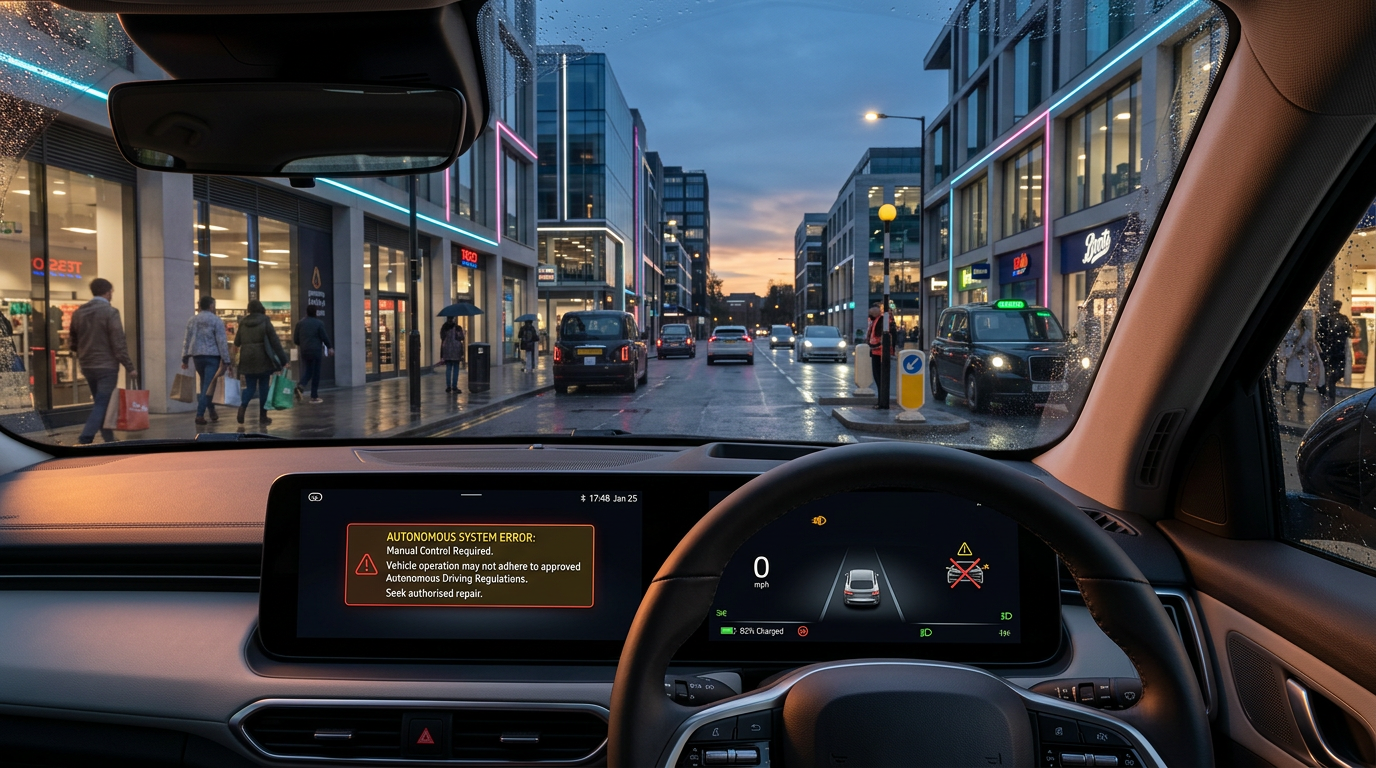
In 2026, the definition of a "faulty car" has shifted significantly. While mechanical issues like gearbox failures or oil leaks still occur, a growing number of UK motorists are finding themselves sidelined by "bricked" screens, phantom braking, and glitchy Advanced Driver Assistance Systems (ADAS).
As autonomous and semi-autonomous features become standard on the UK used car market, a critical question arises for buyers: Does the law protect you if the software—rather than the engine—fails?
Under the Consumer Rights Act 2015 (CRA 2015), the answer is a resounding yes. However, the process of rejecting a vehicle for software bugs is more nuanced than traditional mechanical claims. This guide explores your digital rights and the obligations of motor traders in this automated era.
Consumer Rights Act 2015 and 'Digital Content'
One of the most forward-thinking aspects of the CRA 2015 is its inclusion of "digital content." When you buy a car today, you are not just buying a physical chassis; you are buying a complex integration of hardware and software.
Under the Act, all goods—including the software pre-installed in your vehicle—must be:
- Of Satisfactory Quality: What a reasonable person would expect, taking into account the price and description.
- Fit for Purpose: If you bought the car specifically for its "self-driving" motorway pilot, it must be able to perform that function.
- As Described: If the car was advertised with "Level 2 Autonomy" and a software bug prevents this from working, the car is technically misdescribed.
In 2026, with the UK now seeing more software-defined vehicles (SDVs) on the second-hand market, "software faults blooming" has become a common term in legal circles. If a bug prevents the car from operating safely or as advertised, it constitutes a "breach of contract" under the CRA 2015.
Buyer Rights: The Path to Rejection
If you discover a software fault in your vehicle, the CRA 2015 provides a tiered system of remedies.
1. The Short-Term Right to Reject (First 30 Days)
If a software bug becomes apparent within the first 30 days of purchase, you have a legal right to reject the car and demand a full refund. You do not have to give the dealer a chance to repair or update the software during this window, though many consumers choose to do so.
2. The Right to Repair or Replacement (30 Days to 6 Months)
Outside the initial 30 days, but within the first six months, you must give the dealer one opportunity to fix the fault. In the context of self-driving software, this usually involves a firmware update or a "patch."
- Crucially: If the repair fails—for instance, if the "phantom braking" persists after a software flash—you then have the Final Right to Reject. At this stage, you can return the car for a refund (though the dealer may deduct a "usage fee" for the miles you have driven).
3. Financial Protection (Section 75 & Section 99)
If you purchased the car on finance (PCP or HP), you have additional layers of protection. Under Section 75 of the Consumer Credit Act 1974, the finance provider is "jointly and severally liable" for any breach of contract. Furthermore, if you are simply struggling to keep the car due to ongoing software unreliability, you may have rights regarding "Voluntary Termination" under Section 99, provided you have paid 50% of the total amount payable.
Dealer and Trader Obligations
For car dealers, the liability surrounding autonomous software is high. The Consumer Protection from Unfair Trading Regulations 2008 (CPRs) play a vital role here.
1. Mandatory Disclosure
A trader must disclose all "material information" that might affect a consumer’s decision to buy. If a dealer knows a specific model has a history of software-induced steering "glitches" or that a manufacturer has ceased OTA (Over-the-Air) updates for that model year, failing to mention this could be deemed an "unfair commercial practice."
2. The 'Six-Month' Burden of Proof
Under the CRA 2015, if a software fault appears within the first six months of ownership, the law assumes the fault was present at the time of delivery. It is the dealer’s responsibility to prove the software was perfect when sold—a difficult task in an era of complex, evolving code.
3. Duty of Care and the Road Traffic Act 1988
Traders have a duty to ensure any vehicle sold is "roadworthy." If a software fault affects the braking or steering (components of self-driving systems), selling that car could put the dealer in breach of the Road Traffic Act 1988. Traders cannot hide behind "software is updated by the manufacturer" as a defense; the contract of sale is between the dealer and the consumer.
Is a "Bug" Enough to Reject a Car?
Not every minor UI glitch warrants a full rejection. A "bug" that causes the radio to restart is likely a minor inconvenience. However, a fault in the self-driving suite is a different matter.
In 2026, the UK legal standard focuses on Safety and Functionality. You likely have grounds for rejection if:
- The Adaptive Cruise Control or Lane Keep Assist disengages randomly without warning.
- The car’s sensors (LiDAR/Radar) report "blindness" in standard weather conditions.
- An "Over-the-Air" update fails, leaving the vehicle undrivable (the "Bricked" scenario).
- Corrective software updates are not available within a "reasonable time" or cause significant inconvenience.
Key Takeaways for UK Buyers in 2026
- Software is treated as Goods: Under the CRA 2015, faulty self-driving software is legally no different from a cracked engine block.
- The 30-Day Window is Vital: If the autonomous features are glitchy from day one, act immediately to preserve your Short-Term Right to Reject.
- Document Everything: Take videos of the software glitches (safely or via dashcam) and keep logs of when the system fails.
- Contact the Finance Provider: If the car is on finance, they are often more influential in forcing a dealer to accept a rejection than a private individual would be.
Summary
As we navigate the complexities of UK car digital rights in 2026, the Consumer Rights Act 2015 remains your strongest ally. While cars have become rolling computers, the fundamental principle of UK law persists: if you pay for a product that doesn't work safely or as described, you are entitled to your money back.
Disclaimer: This article is for general informational purposes only and does not constitute legal advice. Legislation can change, and the application of the Consumer Rights Act 2015 depends on the specific facts of your case. Always consult with a qualified legal professional or Citizens Advice before taking legal action.