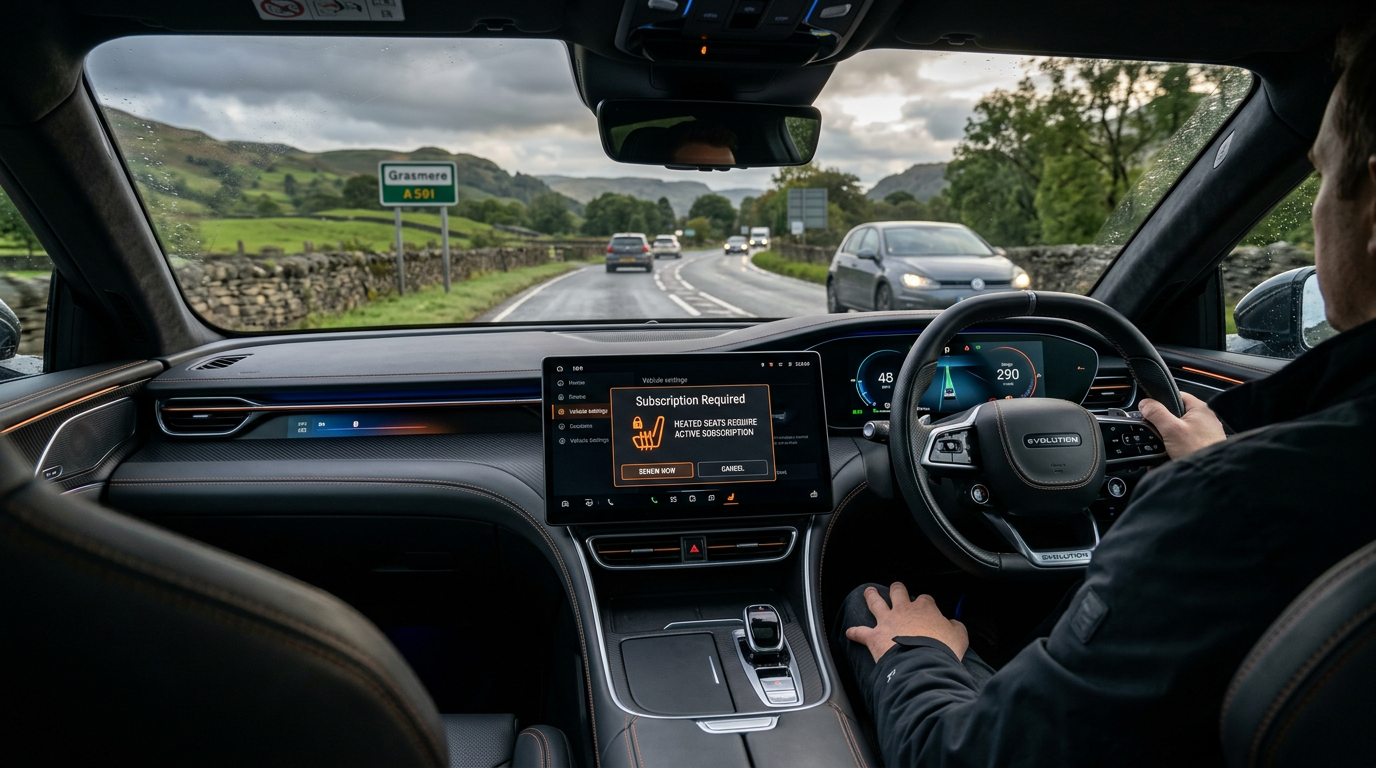
The landscape of car ownership has shifted dramatically in 2026. If you’ve stepped into a showroom recently, you’ll know that the traditional 'factory options' list has been replaced by the Feature-on-Demand (FoD) model. Whether it’s a monthly fee for adaptive cruise control or a subscription to unlock your BMW’s heated seats, the 'pay-to-play' era is here.
But what happens when you buy a car—new or used—under the impression a feature will work, only to find it locked behind a paywall you weren't told about? Or worse, what if the software service you pay for simply fails to function?
In this 2026 guide, we explore your consumer rights under the Consumer Rights Act 2015 and whether you can legally reject a vehicle over in-car subscription disputes.
The 2026 Reality: Hardware vs. Software
By 2026, most major manufacturers including Audi, BMW, Mercedes-Benz, and Tesla have streamlined their production lines. Instead of manufacturing different seats, every car gets heating elements installed at the factory. The difference is the software lock.
While this allows for lower initial purchase prices and a flexible second-hand market, it has created a legal grey area. At CarsLink.ai, we’ve seen a surge in enquiries from buyers who feel misled by 'digital extras' that vanish once the car changes hands.
Can You Reject a Car? The Legal Framework
Under the Consumer Rights Act 2015 (CRA), goods must be:
- As described.
- Of satisfactory quality.
- Fit for purpose.
Crucially, as of the 2022 and 2024 updates to digital consumer protections, the law treats car software rights with the same weight as physical mechanical components.
1. The "As Described" Challenge
If a dealer (new or used) advertises a car as having "heated seats and satellite navigation" without explicitly stating these are subscription-based services that require an additional monthly fee, the vehicle could be deemed misdescribed.
If you discover within the first 30 days that a core feature advertised at the point of sale requires a subscription you weren't notified of, you have a Short-Term Right to Reject. This entitles you to a full refund.
2. Digital Goods and Satisfactory Quality
The CRA 2015 now explicitly covers 'digital content' supplied with goods. If you pay a subscription for a feature—say, Tesla’s Full Self-Driving (FSD) or BMW’s high-beam assist—and the software is buggy or fails to connect to the 6G network (standard in 2026), the car may be considered 'unsatisfactory.'
| Scenario | Can You Reject? | Potential Remedy |
|---|---|---|
| Subscription not disclosed at Sale | Yes (within 30 days) | Full Refund / Rejection |
| Software glitch disables paid feature | Maybe | Repair first, then Rejection |
| Manufacturer ends support for an app | Yes (if core to sale) | Partial Refund / Compensation |
| Second owner loses 'Lifetime' sub | Yes | Claim against Dealer |
The "BMW Heated Seats" Legacy and Modern Precedents
Lower-profile cases in 2024 and 2025 have set the stage for 2026. Most notably, the "Automatic Renewal" disputes handled by the Financial Ombudsman Service have ruled that if a subscription is necessary for a feature listed on the V5C or original invoice, the cost must be transparent.
If you are buying via PCP (Personal Contract Purchase) or HP (Hire Purchase), the finance company is actually the owner of the vehicle. This gives you extra protection under Section 75 of the Consumer Credit Act. If the subscription services fail or are misrepresented, you can hold the finance provider jointly liable.
The Used Car Market Trap
The biggest point of contention in 2026 is the used car market. Imagine buying a three-year-old EV. The previous owner paid for a 'Lifetime' performance boost. However, upon transferring the title via the DVLA, the manufacturer wipes the software and asks you for £500 to re-enable it.
CarsLink.ai Top Tip: Always check the 'Digital Service History' and the manufacturer’s 'Terms of Connectivity' before signing. If the dealer cannot guarantee the permanence of a feature, get it in writing that the price reflects a 'Standard' model without those digital extras.
Steps to Take if You Want to Reject
If you believe you have grounds to reject your car due to in-car subscription fees or software failures, follow this protocol:
- Cease Use: Continued use of the car can be seen as acceptance of the fault.
- Audit the Advert: Save the original CarsLink.ai listing or dealership brochure. If it says "Features: Heated Seats" without "Subscription required," you have a strong case.
- The 30-Day Window: Act within the first 30 days for an unconditional refund. Between 30 days and six months, you must give the dealer one chance to 'repair' the issue (which usually means they pay for the subscription for you).
- Contact the Finance Provider: If on PCP/HP, inform them immediately. They have teams dedicated to 'satisfactory quality' disputes.
The Future of Car Software Rights
The UK government is currently reviewing the Digital Markets, Competition and Consumers Act to further address 'subscription traps' in the automotive sector. The goal is to ensure that 'Hardware-as-a-Service' doesn't leave motorists with 'bricked' features that they technically already paid for when the car was built.
Conclusion
Can you reject a car over subscription fees? Yes, but it hinges on transparency. If the dealer was upfront about the costs, you have no case. If the fees were hidden, or if a paid-for service is malfunctioning, the law is increasingly on the consumer's side in 2026.
Whether you're looking for a fully-loaded EV or a reliable hybrid, ensure your next purchase is transparent. Search the latest listings on CarsLink.ai to find dealers who provide full digital spec disclosures, ensuring you never get caught out by a software paywall.
Disclaimer: This guide is for informational purposes and does not constitute formal legal advice. For specific disputes, consult a qualified solicitor or Citizens Advice.