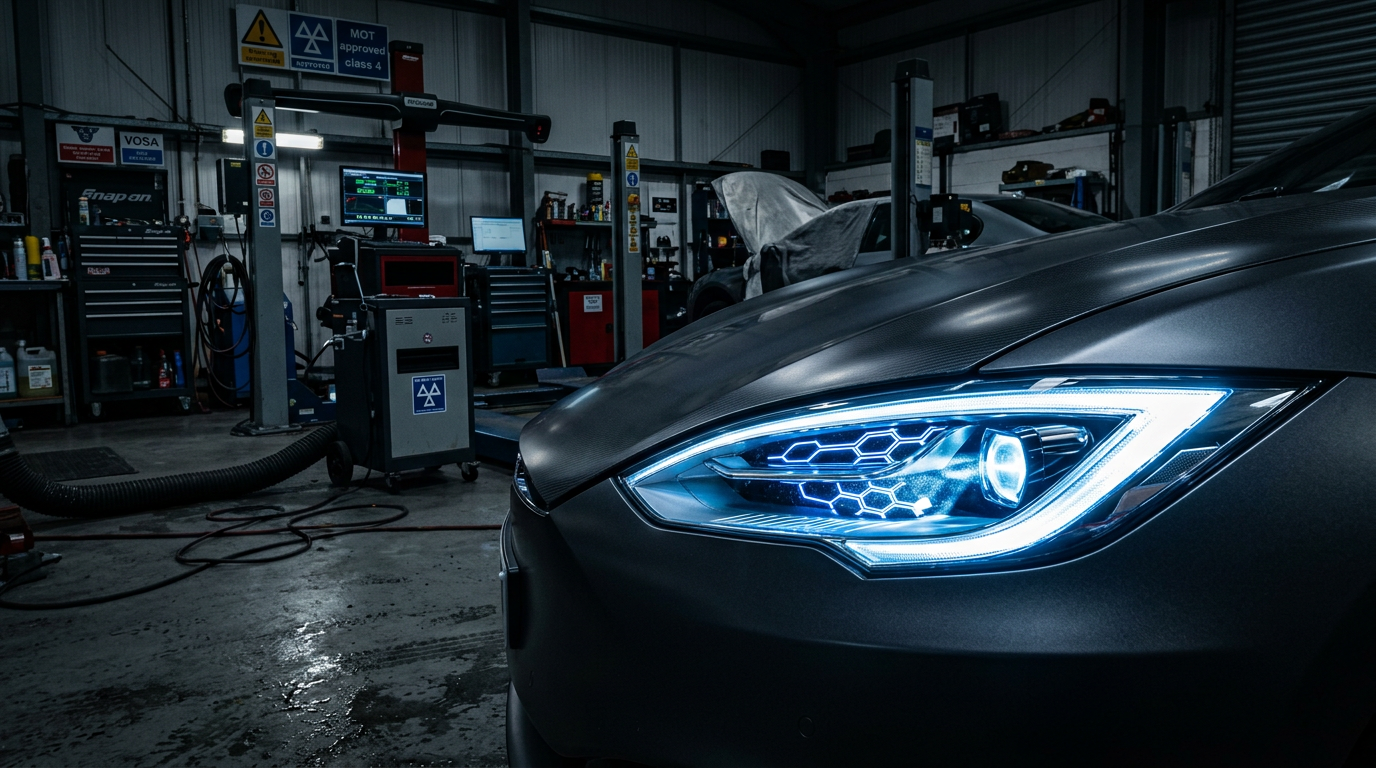
In 2026, the landscape of British motoring has shifted. While electric vehicles (EVs) dominate the new car market, the average age of a vehicle on UK roads has climbed to nearly 10 years. For owners of modern prestige and mid-range cars, a new challenge has emerged at the local garage: the complexity of Adaptive Front-lighting Systems (AFS) and Matrix LED units.
As we move further into the decade, the DVLA and DVSA have tightened the screws on lighting standards. If your car features "smart" lighting, the days of simply checking if a bulb has blown are over. Here is everything you need to know about passing the 2026 MOT with high-tech illumination.
The Evolution of 2026 MOT Rules in the UK
The DVSA updated the MOT inspection manual in early 2026 to reflect the mass adoption of active safety systems. Previously, a "beam pattern check" was a straightforward process of checking height and horizontal aim. Today, the 2026 MOT rules in the UK demand that any "active" element of the headlight must function as intended by the manufacturer.
What constitutes a 'Smart' Headlight?
- Matrix LED: Uses a grid of individual LEDs that can be turned off independently to prevent dazzling oncoming drivers while maintaining high-beam brightness elsewhere.
- Adaptive Lighting: Headlights that physically swivel in the direction of the steering wheel.
- Dynamic Levelling: Sensors on the axles that adjust the beam based on the car's load and pitch.
Under current standards, if your car displays a dashboard warning light related to the 'Adaptive Lighting System' or 'Auto-Levelling,' it is an automatic Major Fail.
Why Matrix LEDs are Failing the MOT
While traditional halogen bulbs slowly dim over time, LED units are binary—they either work or they don't. However, the "Matrix" element adds a layer of complexity.
The most common reasons for an adaptive lighting MOT fail in 2026 include:
- Shadow Failures: In a Matrix unit, individual "pixels" (LEDs) can fail. If a specific segment responsible for the beam pattern is dead, it causes a "hole" in the light distribution, which is now a failure.
- Calibration Errors: If the car has been involved in a minor bump or had suspension work, the cameras (usually behind the rearview mirror) may lose their alignment with the headlights.
- Moisture Ingress: Even slight condensation can interfere with the cooling fans or the sensitive circuitry of an LED driver, leading to intermittent flickers.
The Sting: Matrix LED Repair Costs
The primary concern for second and third-hand owners of cars like the Audi A4, BMW 3 Series, or Tesla Model 3 is the Matrix LED repair cost. Unlike a £15 H7 halogen bulb, these units are typically "sealed for life."
| Component Type | Estimated Replacement Cost (2026) | Serviceable? |
|---|---|---|
| Standard Halogen Unit | £80 - £150 | Yes (Bulb only) |
| Standard Static LED | £450 - £900 | No (Full unit) |
| Smart Matrix LED Unit | £1,400 - £3,200 | No (Unit replacement) |
| Cornering Motor / Actuator | £300 - £600 | Sometimes |
At CarsLink.ai, we often see car buyers overlooking the condition of high-tech lighting when browsing the used market. Replacing a pair of failed Matrix units can often exceed 30% of a five-year-old car's total value. Always check for a "clean" MOT history regarding lighting before committing to a purchase.
Smart Headlight Maintenance: A 2026 Guide
Preventative smart headlight maintenance is the best way to ensure your V5C remains attached to a road-legal vehicle. Here are three steps every modern car owner should take:
1. Maintain Your Suspension
Adaptive lights rely on sensors attached to the car's control arms. These sensors tell the car if the nose is dipping under braking or if the boot is full of heavy luggage. If a sensor bracket rusts or snaps (a common UK issue due to road salt), your headlights may point directly at the floor or into the eyes of oncoming drivers.
2. Keep the Windscreen Clean
Most Matrix systems use a forward-facing camera to "see" other cars. If the area of the windscreen in front of the camera is chipped, smeared, or covered in "traffic film," the lights may fail to mask out oncoming traffic correctly. This can lead to a failure during the "Functionality" check of the MOT.
3. Software Updates
In 2026, many lighting faults are actually software glitches. Ensure your vehicle has the latest "Over-the-Air" (OTA) updates installed. Manufacturers often release patches that recalibrate light sensitivity or repair communication errors between the lighting module and the ECU.
Headlight 'Modding' and the MOT
The DVSA has also cracked down on aftermarket LED conversions. If your car was originally fitted with Halogen units, installing "drop-in" LED bulbs is a Major Fail unless the entire headlamp unit has been replaced with an E-marked, type-approved LED housing. In 2026, testers are equipped with more precise beam-alignment tools that can easily spot the irregular light scatter caused by cheap aftermarket bulbs.
Road Tax and ULEZ Considerations
It is worth noting that while lighting doesn't directly affect your road tax (VED) bracket or ULEZ status, a car that fails its MOT on lighting grounds is legally "off the road." Driving a vehicle with a "Dangerous" or "Major" lighting defect can result in a fine of up to £2,500 and 3 penalty points, potentially voiding your insurance.
Conclusion
The brilliance of Matrix LED technology has made night driving safer than ever, but it comes at a price. As these systems age, the 2026 MOT rules in the UK treat them as essential safety equipment rather than luxury add-ons. If you are buying a used car this year, use the valuation and history tools at CarsLink.ai to ensure the vehicle has been maintained to the highest standards.
Don't let a "shadow" in your headlight beam cast a shadow over your wallet. Regular checks and keeping your sensors clean are the keys to a first-time pass.
Planning your next car purchase? Check out CarsLink.ai to find vehicles with the latest safety tech and transparent MOT histories. Get an instant valuation or find your next ULEZ-compliant upgrade today.