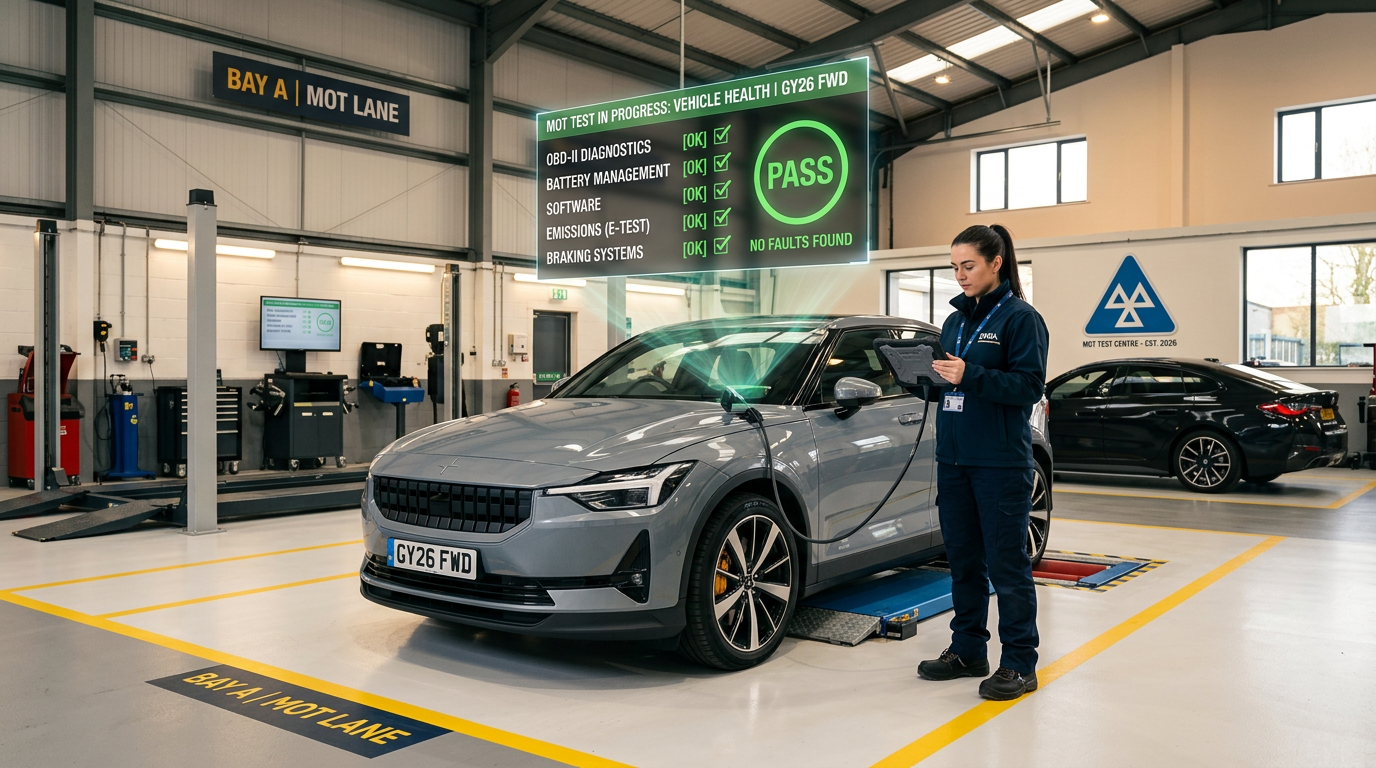
Gone are the days when an MOT test was purely about rust, rubber, and emissions. As we move deeper into 2026, the Driver and Vehicle Standards Agency (DVSA) has fundamentally shifted the goalposts. While the condition of your tyres and brakes remains critical, the 'brain' of your vehicle—its software—is now under the microscope like never before.
With the UK’s 2026 MOT regulations placing a heavier emphasis on connected car safety and Advanced Driver Assistance Systems (ADAS), your vehicle’s code is now just as likely to cause a failure as a cracked windscreen. At CarsLink.ai, we’ve seen a surge in queries from owners of modern EVs and hybrid vehicles wondering why their tech-heavy cars are failing their annual inspections.
Here is your comprehensive 2026 guide to ensuring your car’s software is ready for the MOT tester.
The 2026 Shift: Why Software is Now a Safety Critical Item
In 2026, the distinction between hardware and software has blurred. If your Lane Keep Assist (LKA) or Autonomous Emergency Braking (AEB) isn't functioning due to a software glitch, the DVSA considers that vehicle unroadworthy.
Technicians now use advanced diagnostic tools that plug into your car’s OBD-II port to check for 'Critical Software Faults'. If your car has missed a safety-related OTA (Over-The-Air) update, or if there are persistent error codes stored in the ECU (Electronic Control Unit), you will find a ‘Major’ failure on your MOT certificate.
The 2026 MOT Software Checklist
Before you head to the testing centre, run through these software-specific checks.
1. The Dashboard 'Clean Sweep'
It sounds basic, but in 2026, many warning lights that used to be 'Advisories' are now 'Major' failures.
- ADAS Warnings: If the little icons for lane departure or radar cruise control are amber or red, it’s an automatic fail.
- Battery Management (EVs/Hybrids): Any software-driven warning regarding the traction battery state or thermal management will result in a failure.
2. Verify Your OTA Update Status
Most cars manufactured after 2022 rely on OTA maintenance.
- Check your infotainment screen's 'Software' or 'System' menu.
- Ensure all 'Safety' and 'Recall' updates are installed.
- Pro Tip: Some updates require a strong Wi-Fi connection. If your car hasn't updated because it’s parked in an underground garage with no signal, you could be heading for a fail.
3. Cybersecurity and Connectivity
The 2026 rules have introduced checks for 'System Integrity'. If your car’s software has been unofficially 'modded' or 'chipped' in a way that bypasses safety protocols or emissions controls, the new DVSA diagnostic tools will flag it as a cybersecurity breach.
Hardware vs. Software: What the Tester Sees
To help you understand the balance, here is a comparison of what is being checked in 2026 compared to five years ago:
| Feature | 2021 MOT Status | 2026 MOT Status |
|---|---|---|
| Brake Pads | Physical thickness check | Physical check + ABS/EBD software audit |
| Headlights | Alignment and bulb check | Adaptive Matrix LED software calibration |
| Emissions | Tailpipe probe (ICE only) | ECU data log analysis + Particulate sensor |
| ADAS Sensors | Not tested | Calibration check for cameras and radar |
| Connectivity | Not tested | V2X (Vehicle-to-Everything) integrity check |
The Role of ADAS Calibration
If you’ve recently had a windscreen replaced or a minor bumper scuff repaired, your cameras and sensors may be misaligned. In 2026, the MOT test includes a verification of the ADAS calibration. If the software detects that the radar is pointing 2 degrees off-centre, it won't just be an annoyance—it will be a failure.
If you are looking to buy a used car and want to ensure its software history is as clean as its bodywork, CarsLink.ai provides detailed insights into vehicle health and history to help you make an informed decision.
How to Prepare for the 'Digital' MOT
- Check for Recalls: Use the DVLA recall checker. In 2026, many recalls are software-based. An outstanding safety recall is an automatic MOT failure.
- Ensure Your V5C is Current: While not software, having your digital records in order ensures the MOT system correctly identifies your car’s specific tech trim level.
- Perform a 'Hard Reset': Occasionally, ghost codes can get stuck in a car's memory. If you have an amber light that you know is a glitch, consult your dealer for a software refresh before the test.
- Check Your ULEZ Compliance: While ULEZ is a charging zone, the 2026 MOT diagnostics check if your car’s software is reporting the correct real-world emissions levels. A 'cheater' map or a bypassed DPF will be caught instantly via the software audit.
Common Software Failure Myths
- "I can just clear the codes before the test": False. Modern MOT diagnostic tools can see the 'Time Since Last Clear'. If the codes were cleared 10 minutes ago, the tester may refuse to test the car until it has completed a full 'drive cycle'.
- "Infotainment glitches don't matter": Mostly true, unless that screen is the only way to view the reversing camera or adjust the demister/defogger. If the software prevents the driver from seeing the road or behind them, it's a fail.
Summary
The MOT has evolved from a mechanical inspection into a digital audit. Keeping your car’s software updated isn’t just about getting the latest Spotify interface; it’s about maintaining the safety systems that protect you and your family. By staying on top of your OTA maintenance and ensuring your ADAS systems are calibrated, you can approach your 2026 MOT with confidence.
Are you worried about a car's digital past before you buy? Use CarsLink.ai to browse vetted listings where we prioritise transparency in both hardware and software. Stay safe, stay updated, and keep your car on the road.
Ready to find your next tech-ready vehicle? Explore the latest listings on CarsLink.ai today.