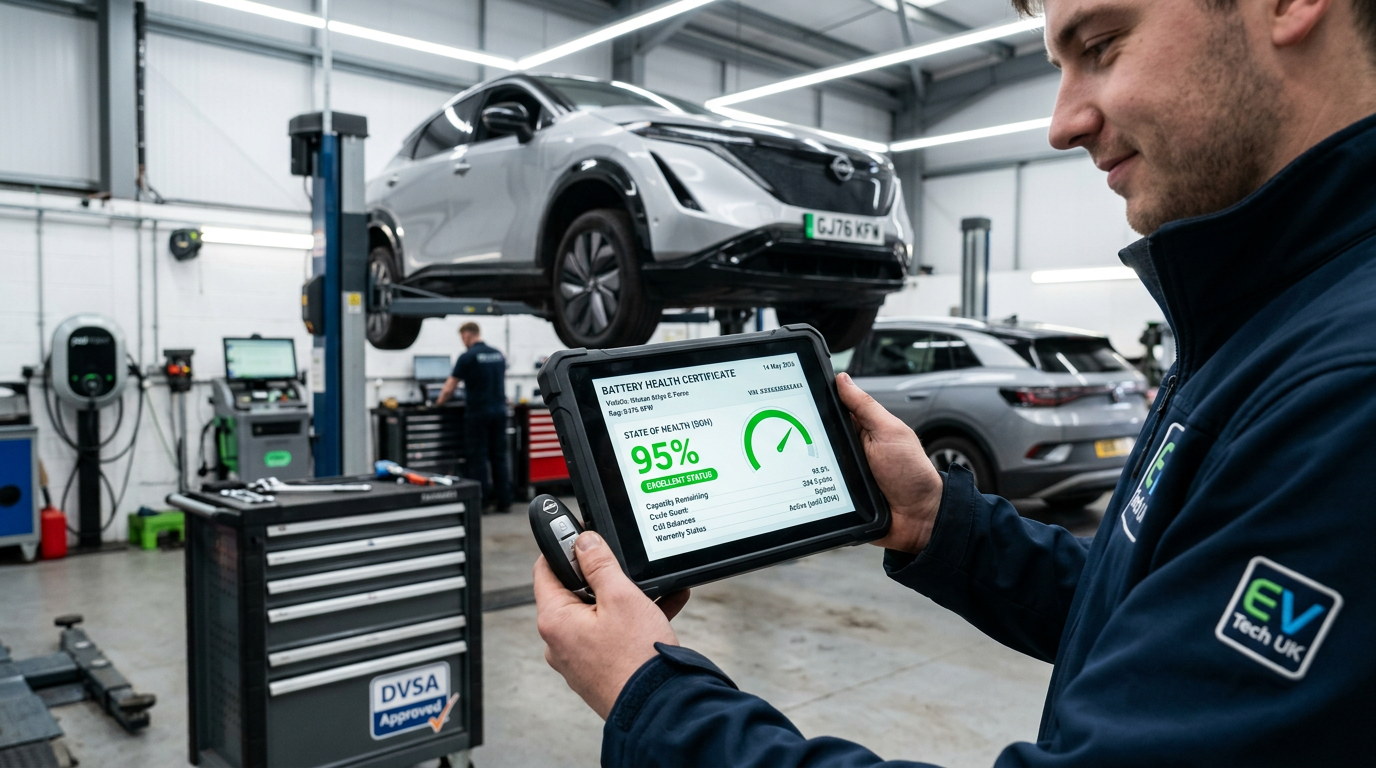
In 2026, the UK automotive marketplace has reached a pivotal tipping point. With more than 40% of the passenger cars on our roads now sporting a plug, the primary concern for buyers and sellers has shifted. It is no longer about "range anxiety"—it’s about battery integrity.
As the first large wave of early-adoption EVs enters the three-to-five-year-old used market, the State of Health (SOH) check has become as vital as an MOT certificate. If you are looking to sell, trade-in, or buy a used electric vehicle this year, a certified battery report isn't just a "nice-to-have"; it is the cornerstone of the car's valuation.
Why 2026 is the Year of the Battery Report
Rewind a few years, and used EV buyers were often taking a gamble. We relied on the dashboard’s range estimator—affectionately known as the "Guess-o-meter"—to judge a battery’s condition. In 2026, that is no longer acceptable.
Several factors have converged to make certified EV battery health certificates essential:
- The Second-Life Market: Many 2021 and 2022 model-year EVs are coming off major PCP (Personal Contract Purchase) agreements. These cars have seen varying degrees of rapid-charging use, which affects degradation differently.
- Transparency Standards: High-quality platforms like CarsLink.ai now prioritise listings that include independent battery diagnostics, giving buyers peace of mind.
- Insurance and Finance: Lenders and insurers are beginning to use SOH data to determine the residual value and risk profile of older electric vehicles.
Understanding State of Health (SOH)
The State of Health (SOH) is a percentage figure comparing the current capacity of a battery to its original capacity when new. For example, a 2023 Tesla Model 3 with an SOH of 94% has lost 6% of its total capacity over time.
While some degradation is natural, "rapid degradation" caused by constant 350kW DC fast-charging or leaving a car sitting at 100% charge in high temperatures can significantly lower a car's resale value.
The Breakdown: What a 2026 Health Check Covers
| Metric | Why it Matters | Impact on Value |
|---|---|---|
| SOH Percentage | Tells you total energy storage capacity remaining. | High (direct link to range) |
| Cell Balance | Checks if individual battery cells are charging evenly. | Moderate (indicates longevity) |
| Cycle Count | How many times the battery has gone from 0-100%. | Moderate (wear and tear) |
| DC vs AC Ratio | The percentage of fast charging vs slow home charging. | Low but influential |
The Impact on Electric Car Resale Value
The used car market in 2026 is data-driven. A car with an EV battery health certificate typically commands a premium of £1,000 to £2,500 over an identical model without one.
For the seller, it proves you have cared for the battery. For the buyer, it removes the fear of a "bricked" battery or a "lemon" that only achieves 60% of its advertised range. At CarsLink.ai, we’ve observed that EVs listed with verified SOH reports sell up to 30% faster than those without.
How to Get a Certified Battery Report in the UK
In 2026, obtaining a report is simpler than ever. You no longer need to leave your car at a dealership for three days.
1. Independent Diagnostic Providers
Companies like Altelium, ClearWatt, and Aviloo provide independent certificates. These often involve a small OBD-II (On-Board Diagnostics) plug-in device that monitors the battery over a few days of normal driving or a single "stress test" charge cycle.
2. Manufacturer-Certified Checks
During your annual service or MOT, most franchised dealers (VW, Hyundai, Kia, BMW) now offer an official battery health printout. While useful, some buyers prefer third-party reports to ensure there is no brand bias.
3. Mobile Technicians
A new breed of mobile EV specialists can now visit your home or workplace, perform a diagnostic sweep, and issue a digital certificate to your V5C logbook or digital wallet in under an hour.
Maintenance Tips to Protect Your SOH
If you are planning to sell your EV in the next 12 to 24 months, your maintenance habits today will dictate your car’s value tomorrow. 2026 car maintenance isn't about oil changes; it’s about thermal management.
- The 20-80 Rule: Whenever possible, keep your battery percentage between 20% and 80%.
- Limit DC Fast Charging: Reserve Ultra-Rapid chargers for long motorway trips. AC 7kW home charging is much "gentler" on the battery chemistry.
- Software Updates: Ensure your Battery Management System (BMS) is always running the latest firmware. Manufacturers often release updates that improve thermal efficiency and charging curves.
- Pre-Conditioning: In winter, use the car's pre-conditioning feature while plugged into the mains. This warms the battery using grid power rather than straining the battery itself while cold.
The Future: Batteries and the Law
As we move closer to the 2030s, the UK government and the DVLA are discussing integrating SOH data into the standard MOT test for vehicles over five years old. While not yet law in May 2026, the industry is moving toward a "Battery Passport" system, where every EV will have a permanent, unchangeable digital record of its health.
Conclusion
The "black box" era of electric vehicles is over. In 2026, transparency is the primary currency in the UK used car market. Whether you’re a dealer looking to move stock or a private owner wanting top pound for your trade-in, the EV battery health certificate is your most powerful tool.
Don't let a lack of data devalue your asset. Before you list your vehicle, ensure you have a certified SOH check to prove its worth.
Ready to find your next electric vehicle or check the market value of your current one? Visit CarsLink.ai for the latest insights, valuations, and certified EV listings.